

William Blake
By William McKegg | May 31, 2023
This is an extract from The Rosicrucian #92 (May 2023)
Among the many famous painters and poets of Rosicrucian ancestry who flared across the artistic and literary horizons in the late 18th and 19th centuries, William Blake stands out as one of the most illuminated minds through whom Divine wisdom flowed. In his ability to symbolise great truths in art, Blake is without peer. His paintings and poems revealed to men and women of his time what the esoteric philosophy of Jacob Boehme had revealed to 17th century Europe. Like other great mystics who wrote inspiring works to assist a struggling humanity out of the dull rut of tradition and bigotry, Blake was little understood and never achieved the fame he deserved during his lifetime. But soon after his death he was recognised as a genius, and today he stands high among the list of England’s immortal minds.
Born in London in 1757, he was the second of five children. His father was a hosier, and fairly prosperous. At the age of eight, young William had beautiful, strange visions. Nature appeared to him not in her usual guise but in the royal splendour of her true Self. He was sternly ridiculed by his elders and others when he related to them what he could see. And once, running in to his mother to tell her he had just seen a vision of the prophet Ezekiel standing under a tree, he received not her approbation for gaining such an honour but a sound thrashing for being too imaginative. However, his ardent desire to create finally caused his parents to permit him to take drawing lessons.
Later on he was apprenticed to James Basire, an engraver to the Society of Antiquaries. Basire sent young William to Westminster Abbey to sketch. There, in Edward the Confessor’s Chapel in the Holy of Holies in Westminster, he copied the heads of deceased kings and queens of old. It was here too that he drew his first picture of importance, ‘Joseph of Arimathea, Among the Rocks of Albion.’
Establishing his Art
Blake was greatly attracted to the story of the Holy Grail, to the magician Merlin and to King Arthur and his Knights of the Round Table, and between the ages of 12 and 20 he wrote his first poems concerning them. Eventually branching out as an artist, he was urged to paint in oils. He tried that for a while but soon discarded it as being inadequate to his style, saying that oil paintings ‘sank’, taking away the brilliance and colour he sought.
Colouring [Blake declared] does not depend on where the colours are put, but on where the lights and darks are put. And all depends on form or outline, on where that is put. Where that is wrong, the colouring never can be right.
His bold assertions and odd views incited the antagonism of various established artists, but they had to admit that his creations possessed a profound beauty of colour and symbolic vision. Frederick Tatham, the friend of his later days and his biographer, said:
Like his thoughts, his paintings seem to be inspired by fairies, and his colours look as if they were the bloom dropped from the brilliant wings of the spirits of the prism.
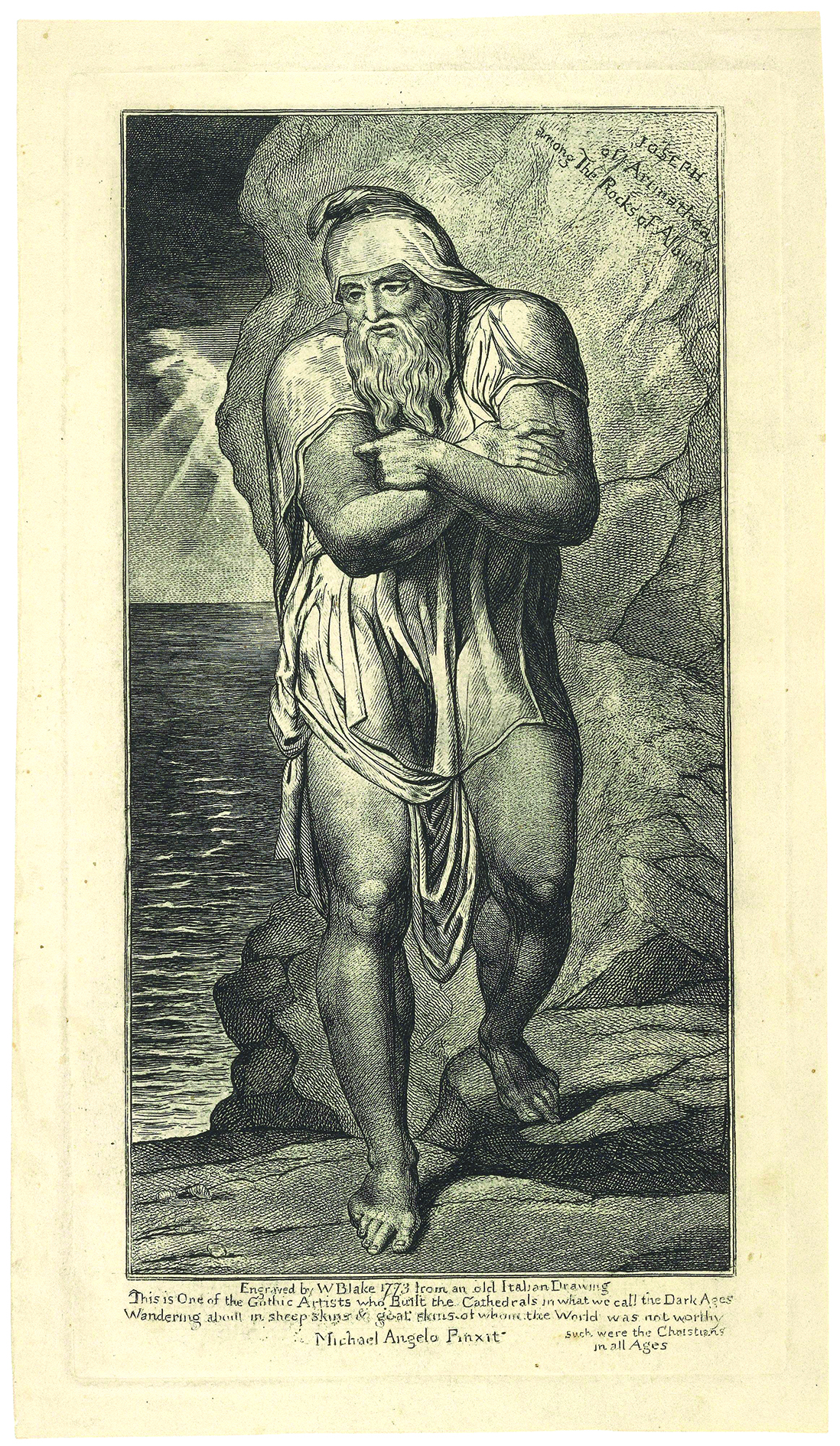
'Joseph of Arimathea, Among the Rock's of Albion'
At the age of 24, Blake fell in love with a young girl who did not, however, return his affections. Taken ill, he went into the country to regain his health and there stayed with the Boucher family. There he met their daughter Catherine, whose sympathy and care attracted him to her. A year later they were married, and a devoted union of ideal beauty existed between the two until Blake’s death in his 70th year. Four years later his wife passed away.
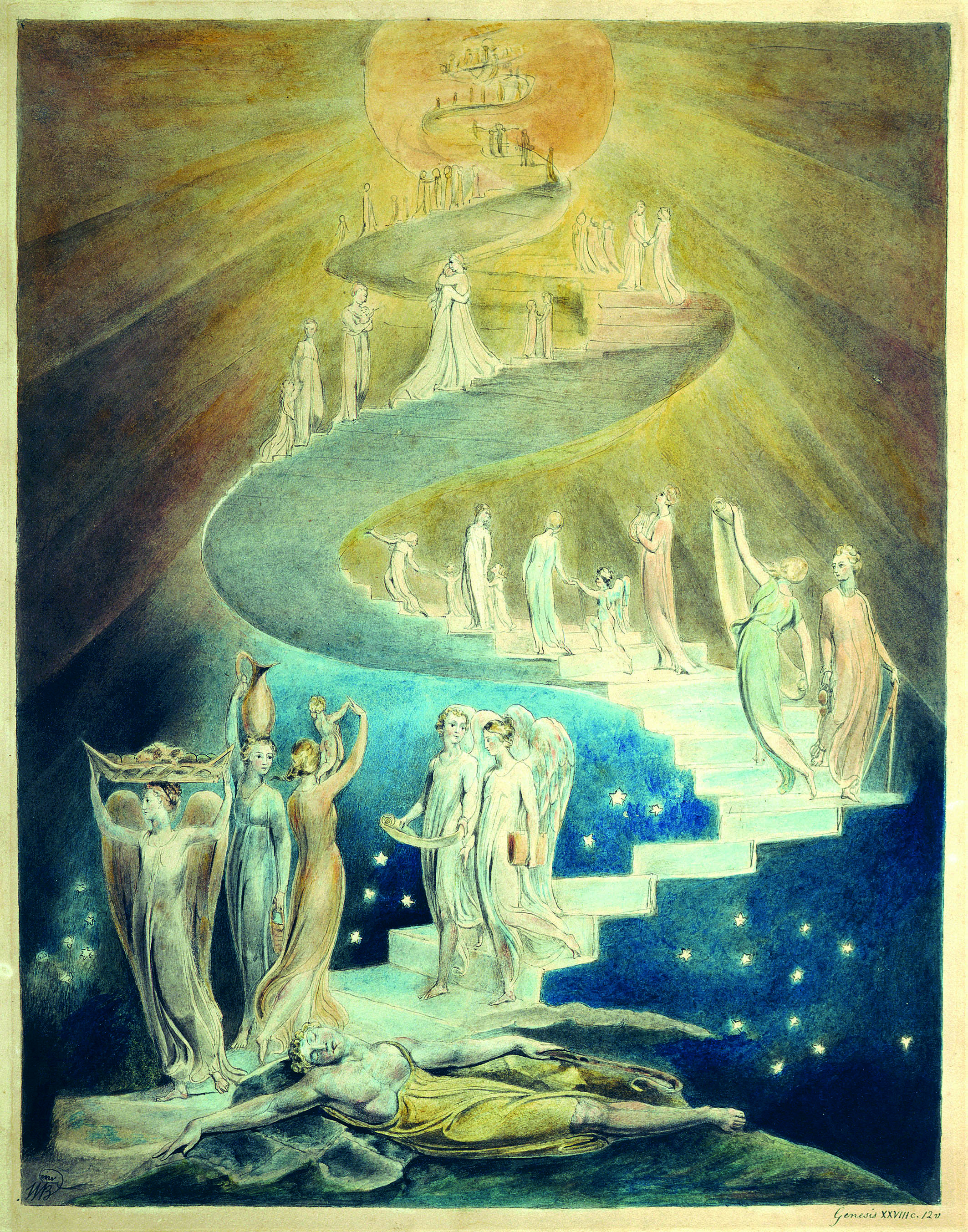
Blake's portrayal of Jacob's Ladder', the dream that the biblical patriarch Jacob envisions during his flight from his brother Esau, as described in the book Genesis 28: 11-19
Imagination
Blake asserted to his friends, among whom were some of the most famous men of his time, that he had the power of bringing his imagination before his mind’s eye so clearly that he could not go wrong in his designs. He also said that he was often the companion of spirits who taught and advised him. His exquisite, hauntingly beautiful painting ‘The Vision of Jacob’s Ladder’ reveals in an instant to every true mystic what Blake was referring to. He similarly declared that he had the power of calling upon the deceased from the past and of conversing with them about their painting methods. His own creations compared, strangely enough, with those of the Cinquecento (16th century) period. He held the works of Raphael and Michelangelo in deep veneration.
As a mystic, Blake had revealed to him the Divine Wonders of the Universe and the secrets of Nature. Once, when a prospective patron commented that his designs were a bit too unreal, Blake replied:
The tree which moves some to tears of joy is in the eyes of others only a green thing which stands in the way. Some see Nature all ridicule and deformity, and by these I shall not regulate my proportion: and some scarce see Nature at all. But to the eyes of the man of Imagination, Nature is Imagination itself. As a man is, so he sees. To me this world is all one continued vision of fancy, or imagination, and I feel flattered when I am told so.
Why [he later said] is the Bible more entertaining and instructive than any other book? Is it not because they are addressed to the imagination, which is spiritual sensation, and but immediately to the understanding or reason? Consider what Lord Bacon says: ‘Sense sends over to imagination before reason has judged, and reason sends over to imagination before the decree can be acted.’ I am happy to find a great majority of fellow mortals who can elucidate my visions, and particularly they have been elucidated by children who have taken a greater delight in contemplating my picture than I even hoped.
Indifference to Worldly Wealth
Blake had one horror in life…, the fear of wealth, which he habitually declared, “destroys creative art.” He was neither rich nor poor, and those who were closest to him affirmed that he always appeared to have sufficient on which to live and make himself and his wife happy and contented. They were both known to be very charitable, never failing in kindness, and always having some money to spare for anyone greatly in need of it.
Blake lived as many mystics before and since have lived…, with complete indifference to the glitter of material wealth. But he was never understood; many in fact regarded him as mad. A person prompted only by idle curiosity would get a bewildering reply to any question he put to him, which confirmed his suspicion that Blake was insane. But, to a soul eager for knowledge and enlightenment, Blake showed himself to be a font of profound wisdom. His life was lived in this world but he was not of it…, sharing his angelic visions on paper and in his written words, for the few during his lifetime who knew him for the great mystic he was.
Messengers from Heaven
When his youngest brother died, Blake declared that he had appeared to him one night and disclosed a method whereby he could invent and put to use what he later called ‘Illuminated Printing.’
I am not ashamed, afraid or averse to tell you [he wrote to a friend] what ought to be told; that I am under the direction of messengers from heaven, daily and nightly.
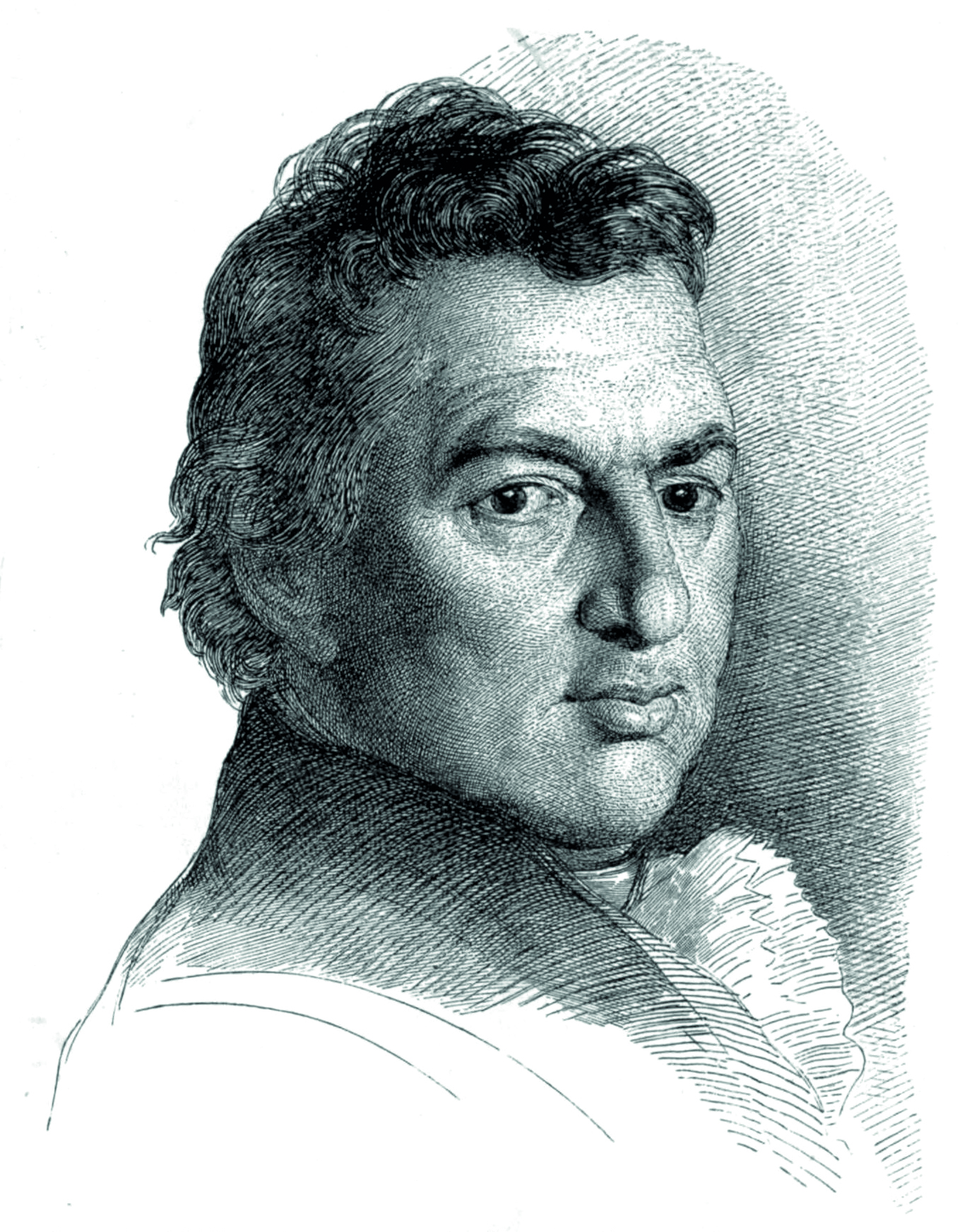
William Blake
All who aspire to a life of sanctity and closeness to God will at least once go through a period of despair…, a seventh period or dark night of the soul. Blake’s mystical pictures and poetry met with ridicule from critics and those jealous of his prowess, and this rejection of his artistic efforts eventually led him to his darkest hour, and his world appeared to crumble about him. He left London and placed his talents at the disposal of a rather exacting friend who had an eye more on financial gain than artistic furtherance. Much against his grain, Blake made miniatures. He deserted ‘imaginative’ art, which is ever the highest, for ‘imitative’ art, which, though possibly more lucrative, carries with it no satisfaction, no worth.
I say this much to you [he wrote to one of his most intimate friends], knowing that you will not make bad use of it. But it is a fact too true that, if I had only depended on mortal things, both myself and my wife must have been lost. I shall leave everyone in this country astonished at my patience and forbearance of injuries upon injuries; and I do assure you that, if I could have returned to London a month after my arrival here, I should have done so. But I was commanded by my spiritual friends to bear all and be silent, and to go through all without murmuring.
It would appear from Blake’s inference that he was passing through a great test. Rosicrucians know this period as ‘the dark night of the soul’, a period through which he was passing and from which he emerged, shining with an inner light that burned all the more brilliantly after its temporary inactivity. Soon he was back in London where he renewed his former life and work.
The Wonders in Humanity
Blake was aware of the wonders within the human being. He was eager to enlighten others by revealing the powers they could attain from within themselves if they would but put to use various simple, natural laws.
Oh! What wonders are the children of men! [he wrote] Would to God that they would consider it, that they would consider their spiritual life, regardless of that faint shadow called natural life, and that they would promote each other’s spiritual labours, each according to its rank…. If the doors of perception were cleansed everything would appear to man as it is, infinite. For man has closed himself up till he sees all things through narrow clinks of his cavern.
The True Spiritual Life
Imagination was the word Blake used when alluding to true spiritual life.
I know of no other Christianity and of no Gospel than the liberty both of body and mind to exercise the Divine Arts of Imagination: Imagination, the real and eternal World of which this Vegetable Universe is but a faint shadow, and in which we shall live in our Eternal or Imaginative Bodies, when these Vegetable Mortal Bodies are no more.
While his mystic paintings may have appeared odd to the average person, they certainly appealed to those who sought spiritual Light, and were regarded with high esteem by some of the greatest artists of the time. Both Romney and Fuseli were ardent admirers of Blake’s paintings, as Coleridge and Wordsworth were admirers of his poetry. He read books in their original languages, which he taught himself…, and when he was past 60 he read Dante, though before then he knew no Italian.
Transition
Shortly before his death, while in bed, he executed his most distinguished picture ‘The Ancient of Days Striking the First Circle of the Earth.’ It was suggested to him by the lines in Book VII of Paradise Lost beginning with “He took the golden Compasses….”
Blake spoke calmly of the approach of his transition to a higher realm and did not consider it as a death in anything but name. We are told that the happiest and most joyous period of his life was the hour before he passed away. He sang in a manner so beautiful that those who heard it were held moved beyond words by its mystic import.
His bursts of gladness made the room peal again. [Tatham relates] The walls rang and resounded with the beatific symphony. It was a prelude to the hymns of saints. It was an overture to the choir of heaven. It was a chant for the response of angels. Then his spirit departed like the sighing of a gentle breeze.
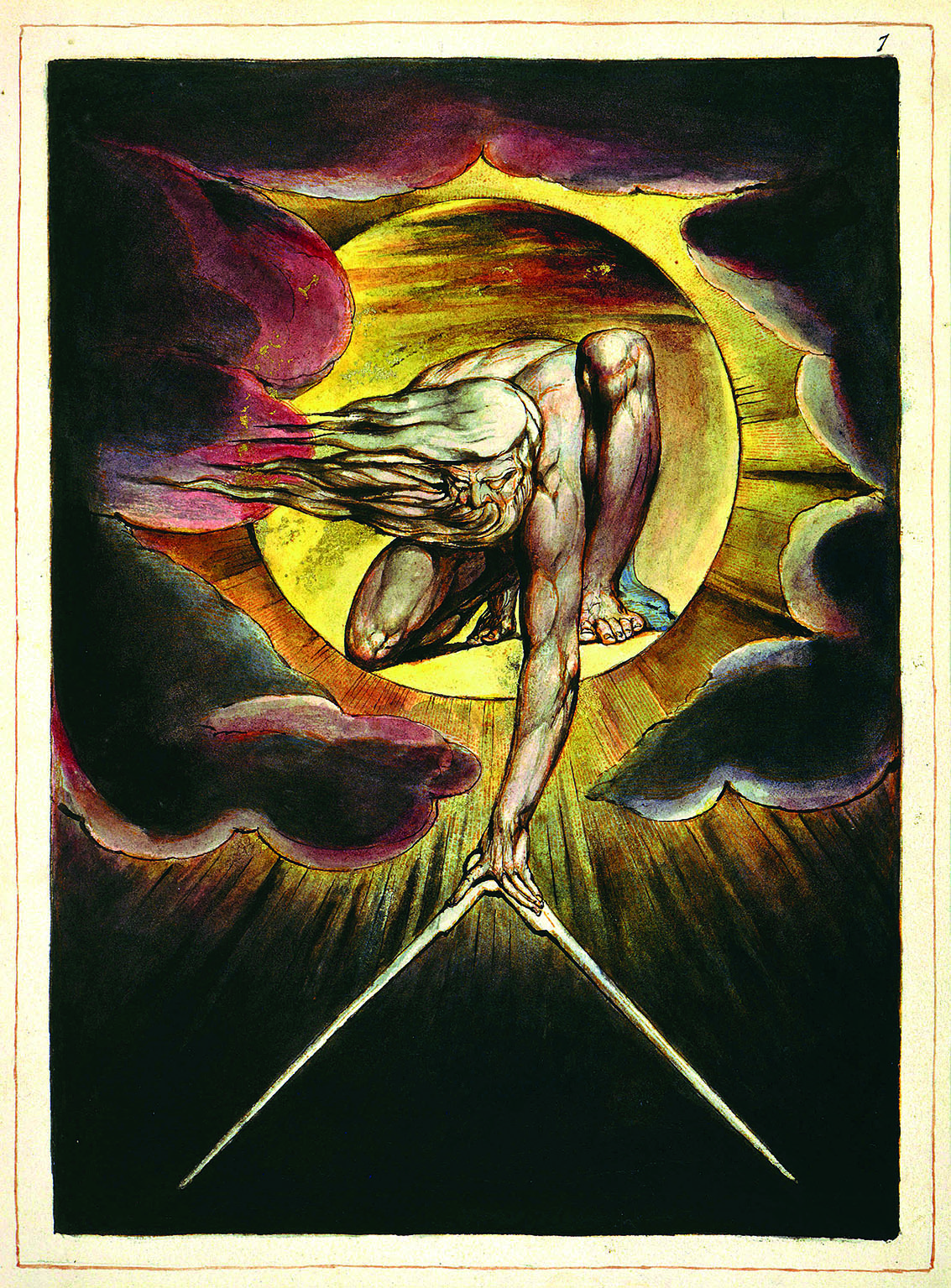
The Ancient of Days Striking the First Circle of the Earth.
Another friend wrote of him:
He was more like the ancient pattern of virtue than I ever expected to see in this world; he feared nothing so much as being rich, lest he should lose his spiritual riches. He was at the same time the most sublime in his expressions, with the simplicity and gentleness of a child.
The predominant truth William Blake expounded throughout the nearly 70 years of his life may be summed up in one of his own lines:
Nature has no Outline, but Imagination has. Nature has no Tune, but Imagination has. Nature has no Supernatural and dissolves: Imagination is Eternity.
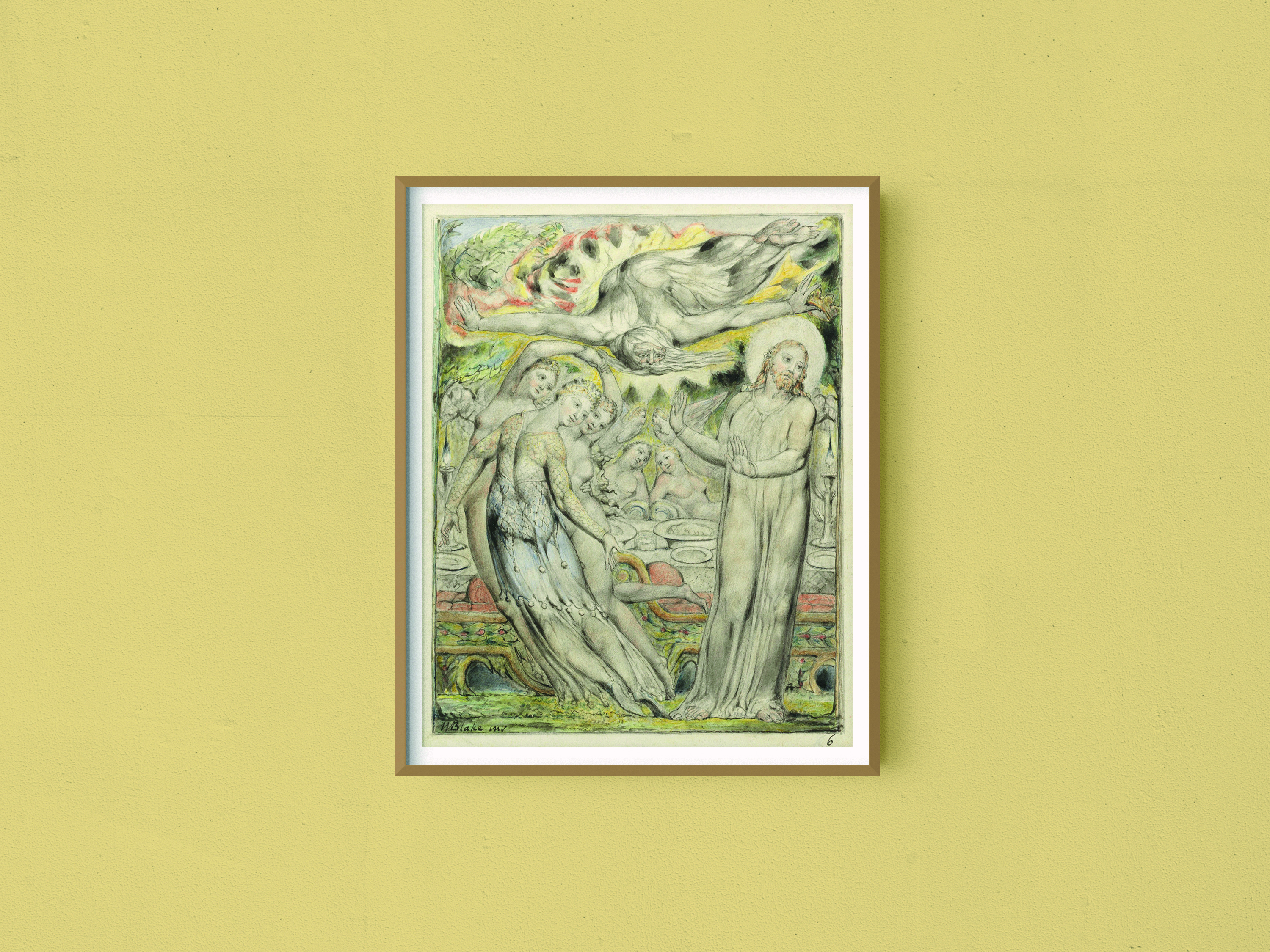
Christ refusing the banquet, William Blake