

SOCRATES
By Jean Ewing | May 30, 2023
This article is an extract from The Rosicrucian #92 (May 2023).
Michelangelo said to the young sculptor: Don't trouble yourself too much about the light on your statue; the light of the public square will test its value.
Truth comes forth to speak for herself. Finding no audience in the masses, she stands eternally, waiting to be recognised by the few. So it is with the truth of Socrates.
MOST of what we know about Socrates and his quotations that we read comes from the dialogues of Plato. These dialogues resemble plays, with Socrates featured as the main character. Through his conversations with others, Socrates comes to life, a mystic engaged in a mission given to him by the Greek god Apollo.
Socrates (Σωκράτης) (c.469–399 BCE) was a classical Greek philosopher who is credited as one of the founders of Western philosophy. He is an enigmatic figure, known not through his own writings but through those of his pupils Plato and Xenophon, and through Plato’s pupil Aristotle but also through sideswipes from the comic dramatist Aristophanes. According to Plato, Socrates’ father was Sophroniskos and his mother Phainarete. Though said to be unattractive in appearance and short in stature, Socrates married Xanthippe, who was much younger than he was. She bore him three sons, Lamprokles, Sophroniskos and Menexenos.
Socrates lived during a time of transition, from the height of the Athenian hegemony to its decline with the defeat by Sparta and its allies in the Peloponnesian War (431–404 BCE). At a time when Athens sought to stabilise and recover from its humiliating defeat, the Athenian public may have been entertaining doubts about democracy as an efficient form of government. Socrates appears to have been a critic of Athenian democracy, and some scholars interpret his trial as an expression of political infighting.
Dialectic
In the dialogue entitled Apology (Aπολογία), Socrates tells the court that at first he was puzzled because the oracle of Apollo at Delphi had said that no one was wiser than he.
What can the god mean, for I know I have no wisdom. Yet he is a god and cannot lie.
Socrates set out to find someone wiser than he but, finding none, concluded about each one he spoke with...
I am better off than he is, for he knows nothing, yet he thinks that he knows. I neither know nor think that I know.
The truth of the riddle is revealed in the following quote:
Only the god is wise. The god is only using my name by way of illustration, as if he said, “He, O men, is the wisest, who, like Socrates, knows that his wisdom is in truth worth nothing.”
And so I go about the world, obedient to the god, and search and make enquiry into the wisdom of anyone who appears to be wise. And if he is not wise, then in vindication of the oracle I show him he is not wise.

Plato
Socrates demonstrated through his dialectic method of teaching that people were not wise. Dialectic is defined as the art or practice of examining statements logically, as by question and answer, to establish validity; but in the dialectic of Socrates much more can be seen. He comes across as a man with a good sense of humour who knows much, pretends to know nothing, and uses wit and irony to their fullest.
When someone enquires as to the nature of something, Socrates pretends to know nothing about it; he replies with a question. Thus he continues until, with his clever enquiries, he has led the other person to answer his own question. When Socrates sees someone showing off, pretending wisdom, he points out the folly of his words, again using questions. He blatantly leads the pretender to what’s true by showing him what’s not true. He called himself an intellectual midwife and said that anxieties are labour pains. He didn’t have the ideas, he said; he helped others have them or find them.
To Know the Truth
Socrates believed absolute truth, knowledge, beauty and goodness exist eternally, and that we know and recognise these qualities on Earth because we remember them from a previous existence in which we dwelt with them. In another dialogue, Phaedo (Φαίδων ), he says:
After descent to earth, the soul has its reminders of the world of true being. Our learning is often remembering what we once knew in another life.

With his questions, Socrates helped the enquirer remember his answers. His two most famous quotes are probably “Know thyself!” and “The unexamined life is not worth living.” His major concern was ‘the good life.’ Before him, philosophers had been mainly concerned with the nature of the heavens and earth, but Socrates said he wasn’t concerned with how or of what the universe was made but why it was made as it was. He focused his attention on the inner self and on the acquisition of happiness. Believing that true goodness and happiness are one and the same, he believed that we can become rational and that through a process of arete (αρετή: moral excellence or virtue, or just becoming expert at something) we can find fulfilment. Everyone, he thought, should live up to his or her full innate potential.
The absolutes spoken of by Socrates are essences, forms or ideas remaining after the thing that represents them has departed. He believed that we are able to partake of these absolutes because we remember them. An example is the idea of beauty that remains after the flower we thought beautiful has wilted. This idea of beauty is also the flower’s true nature and, knowing its nature, one can also know its purpose. It is no accident that there is such variety in the universe, thought Socrates; everything has its purpose in relation to the whole. There is one function that each person or thing performs better than any other person or thing…, and that function is its purpose, its reason for being.
Knowledge is a Virtue
If we seek knowledge and learn what is truly good, we will act in our own best interest. Socrates believed that knowledge breeds understanding,.. leading to goodness and a good life. Mistakes are made because of a lack of information. If one knows what is best, one will do what is best. No person harms him or herself intentionally. Consider a woman who steals. She must believe that the acquisition of the thing she steals will bring her happiness. Does a man who kills not believe that either he or the world will somehow be better off without his victim? “Knowledge is virtue”, said Socrates.
Our true nature is good. We have a built-in safety mechanism that gets us back in the flow when we leave it. No person or group can continue indefinitely behaving in a manner that is harmful to his or her personal interests, or for that matter the interests of others. If one tries it, things do not turn out right. So, to find true happiness one must find true goodness.
Trial by the People
As with many of the great teachers throughout history, Socrates was unpopular with the masses. His life ended in Athens in 399 BCE, the same place it had begun 70 years before. He was ordered by the court to drink the poison hemlock after being found guilty of not worshipping the state gods, of introducing new and unfamiliar religious practices, and of corrupting the youth of the city.
At his trial, he was given the opportunity of changing his ways, but he would not. He said he believed his trial and its results were in his best interests. Speaking of his δαίμων (daimon or inner companion), he says:
This sign, which is a kind of voice, first came to me when I was a child; it always forbids but never commands me to do anything that I am going to do. Hitherto the divine faculty, of which the internal oracle is the source, has constantly been in the habit of opposing me, even about trifles, if I was going to make a slip or error in any matter; and now, as you see, there has come upon me that which may be thought and is generally believed to be the last and worst evil. But the oracle made no sign of opposition. It is an intimation that what has happened to me is good, and that those of us who think death is an evil are in error. For the customary sign would surely have opposed me had I been going to evil and not to good.
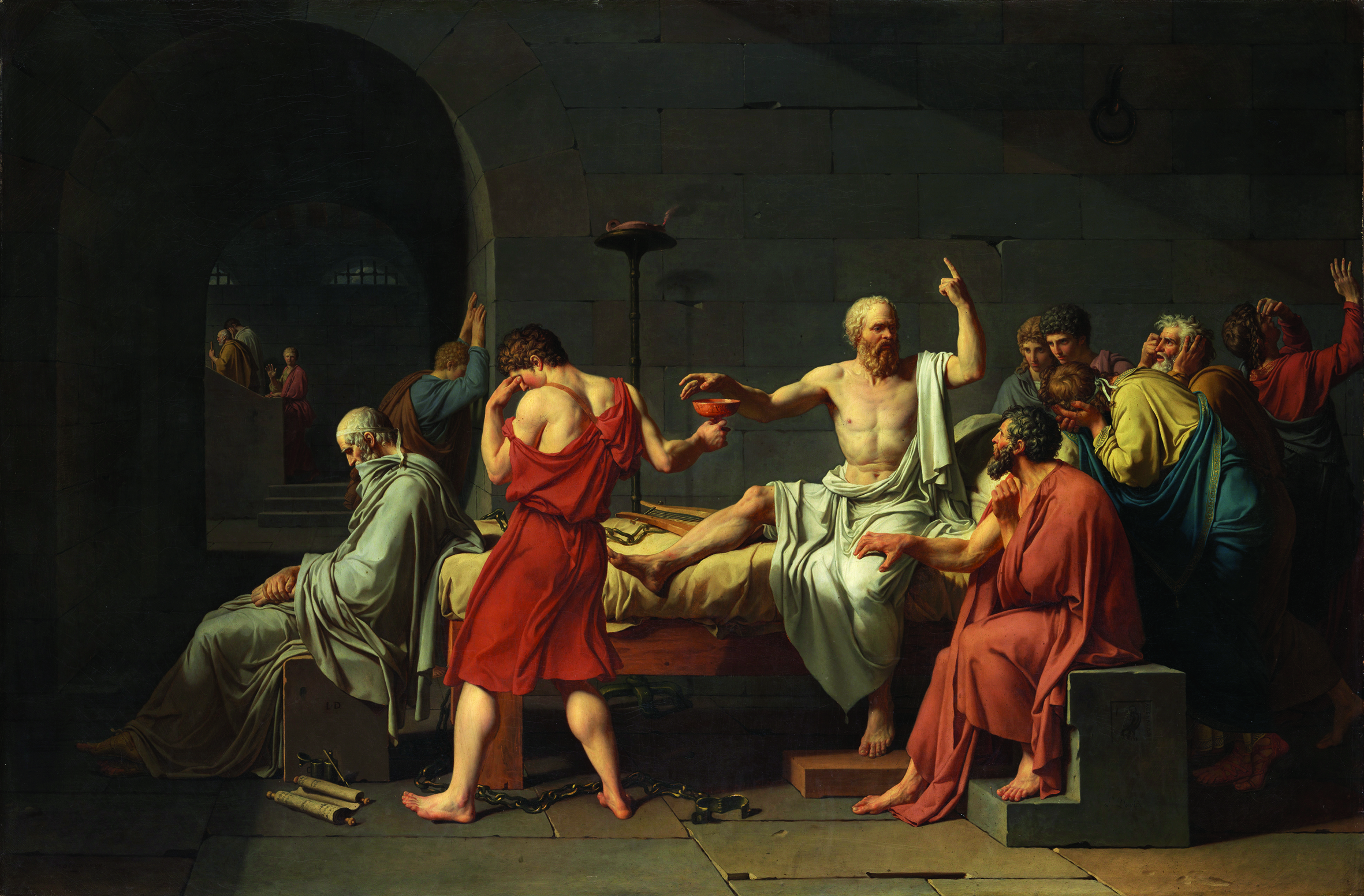
The Death of Socrates by Jacques-Louis David (1787). Socrates was visited by friends in his last night at prison.
Enter Plato
The concept that life necessarily follows death, because opposites spring from opposites, is believed to be that of Plato, although Plato attributes it to Socrates. Many believe it is impossible to truly separate Plato’s philosophy from the philosophy of Socrates in the dialogues. In many instances it is believed that Plato used Socrates as a mouthpiece through which he expressed his own views. What does it matter? Is the message not the important thing? How often do you hear a quote that you think wise, and in time remember the quote but not who said it? Truth does indeed speak for herself.
Perhaps Plato had a purpose for mixing his ideas with those of Socrates so as to render them indistinguishable. Somehow this seems to reinforce the philosophy of Socrates, namely, that it is a waste of time arguing over things all wise people disagree about whilst searching for a knowledge that would do us no good if we had it. What good would it do us if we knew? It also protects us from the trap of respecting the teacher but not the message. After all, if Plato wanted the credit, all he had to do was claim it. Plato loved Socrates like a father who had been his teacher for twenty years. The dialogues were written after the death of Socrates.
Could it be that Plato merely recognised truth standing and wished to preserve her because Socrates, his beloved teacher, never wrote a line? Preserve her he did; she stands, still waiting. The light of the public square has not found her wanting.