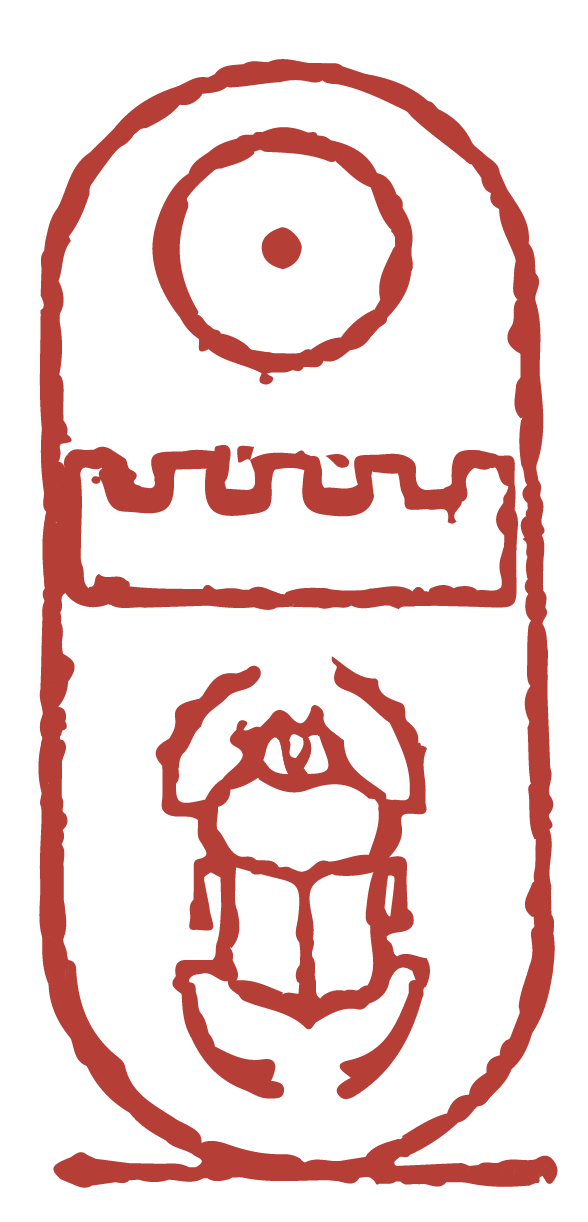

The Eye in Ancient Egypt
By Paul Goodall | Feb 06, 2023
This is an extract from The Rosicrucian #91 (Feb, 2023).
The importance of the eye to ancient Egyptians stems from its status as the premier organ of perception. As such, it was seen to express abstract qualities like consciousness, intelligence, knowledge and understanding. Having the ability to discriminate between light and dark, this led to it being regarded as a religious symbol. The Egyptians also believed that power emanated from the eyes, eventually leading to the concept of the ‘evil eye.’ In order to combat its influence, an amulet was worn as a protective piece of jewellery featuring the eye in the form of the wedjat symbol, commonly known as the Eye of Horus.
Although the origin of this symbol is uncertain, the use of the wedjat in Egyptian iconography was widespread and extensive, and it is the most numerous of all amulets found in archaeological excavations. It depicts the highly stylised eye of the falcon god Horus. On examination it will be seen that this depiction is an amalgamation of human and falcon form. Beneath the human eye can be seen the moustachial stripe, the characteristic feature that is found under the eye of the bird in nature.
Horus was the son of Osiris and Isis and, as such, one of the primary gods of the Egyptian pantheon. According to Egyptian mythology, Horus fought against Set, his uncle, in order to avenge the death of his father, whom Set had killed. During the battle Set tore out the left eye of Horus, shredding it into pieces. These were discovered by Thoth, the god of wisdom and writing, who reassembled them by magic. Myths such as these are prone to variation, however, and some say that it was Hathor who healed Horus’s eye.
From this myth was derived the method of representing fractions in arithmetic whereby each separate part of the wedjat was assigned a certain fractional value. In hieroglyphic writing these elements were used to indicate fractions in accounting. The sum total of these parts, however, amounted only to 63/64th, not quite a whole, but the Egyptians presumed that Thoth’s magic made up the remaining 1/64th.
Taken together, both eyes of the falcon god Horus expressed duality. The right eye represented the sun, and the left, the moon. As a funerary amulet this was indicated physically by the different material used for manufacturing each eye; the solar eye was made from red jasper (a type of quartz) and the lunar eye from lapis lazuli (a blue mineral). The two eyes were frequently paired together and it was common to see them painted on the left (east) side of coffins. The mummy would be turned onto the left side to enable it to use the eyes to look out. In effect, the corpse was facing east toward the living rather than westward into the underworld, which demonstrates that the Egyptians were not totally preoccupied with death.1 This method of using the eyes was also employed on boats to allow the path ahead to be seen and thus afforded advance protection to the sailors, a practice that is still carried on to this day.
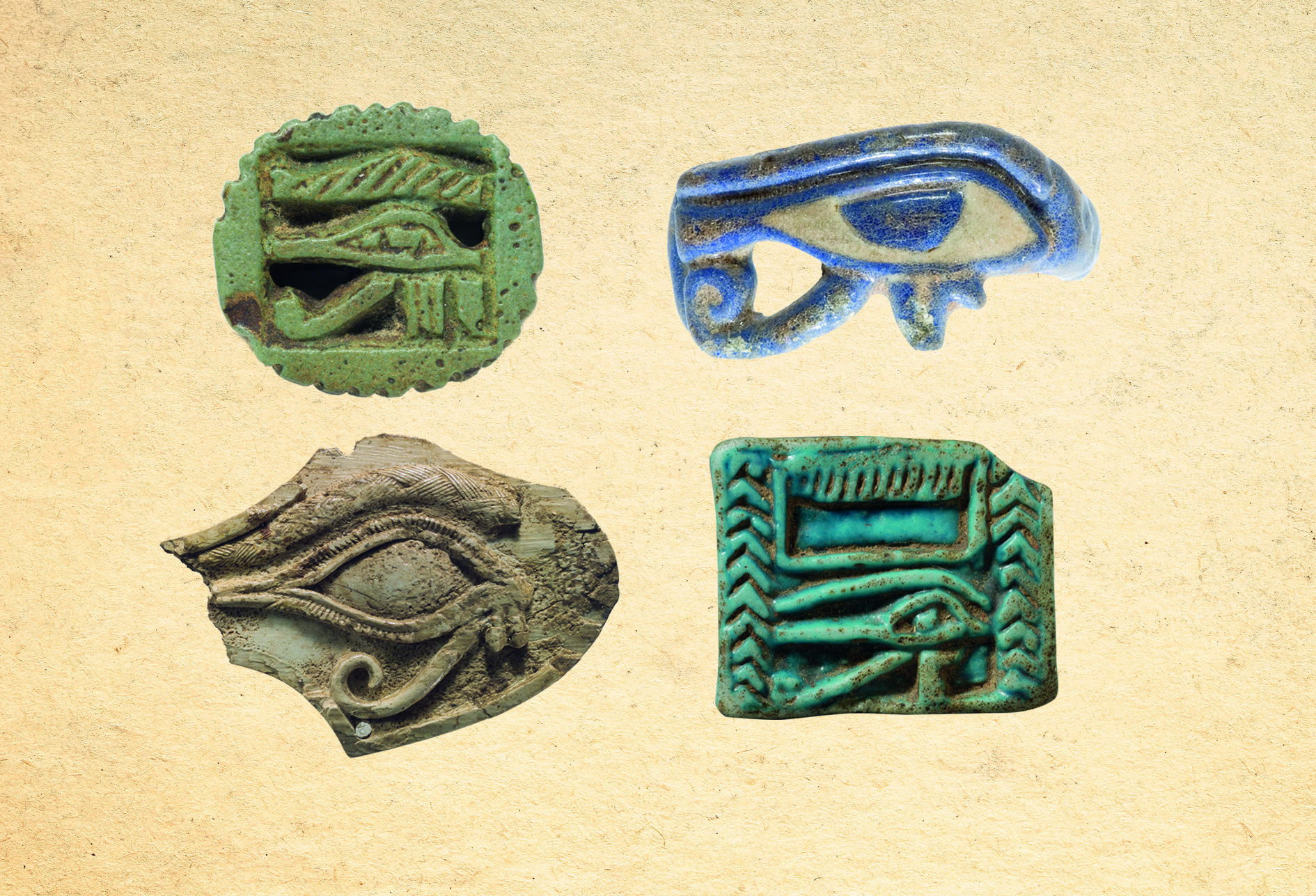
Protective pieces of jewellery featuring the eye in the form of the wedjat symbol, commonly known as the Eye of Horus.
Protection was the prime motive for the use of the wedjat, and representations of this symbol abound. Amulets and jewellery were the main artefacts to incorporate the sign, but also plates inscribed with the wedjat were placed over the incision through which the viscera were removed from the deceased during the embalming process. Ornate pectorals were another way of displaying the sacred eye for protection. Winged eyes were encountered too, hovering over gods and kings.
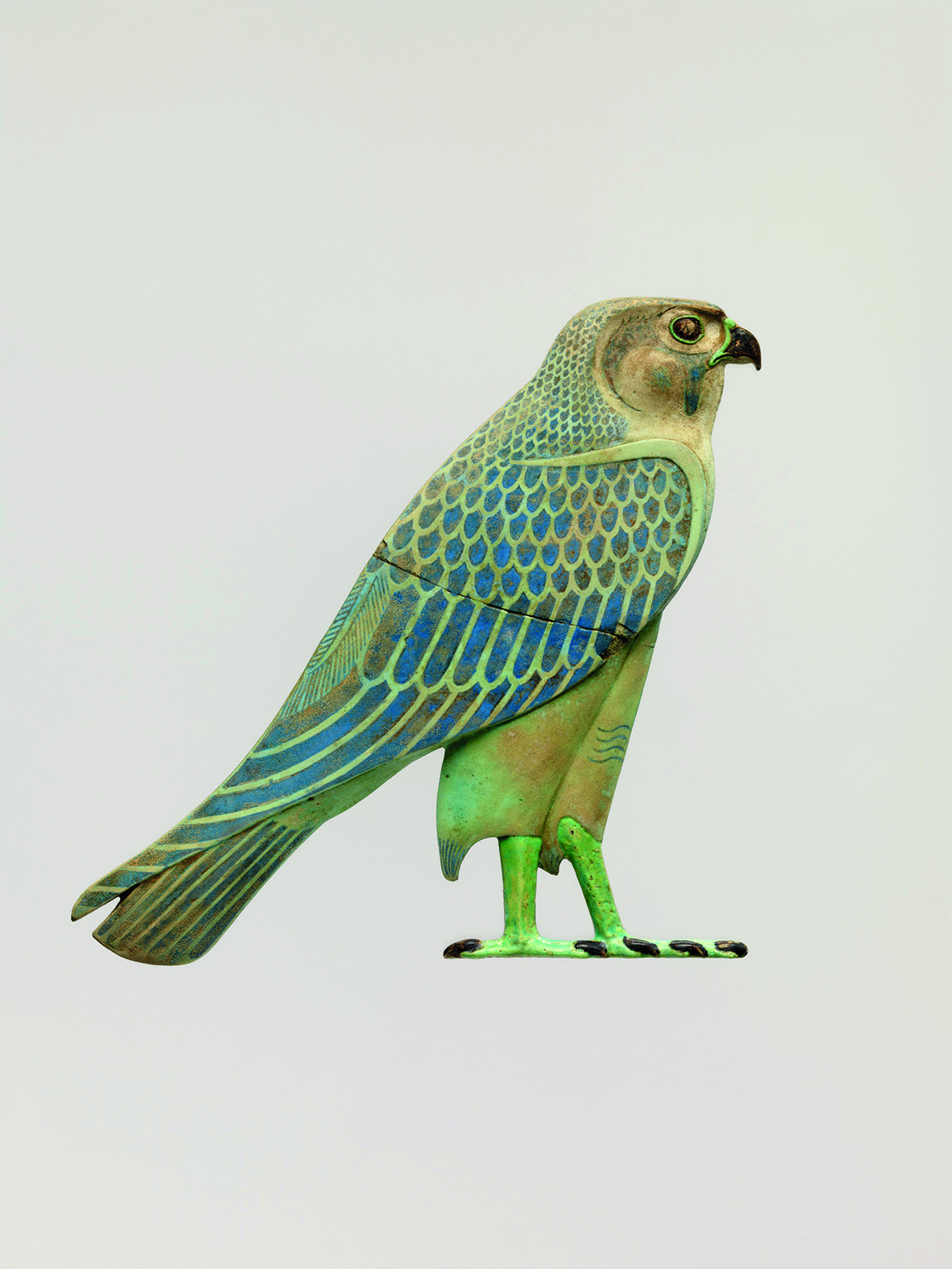
Ancient Egyptian inlay in the form of the falcon-headed god Horus.
Yet another function of the sacred eye, derived from mythology, was its use as a symbol of offering based on the presentation of the restored eye by Horus to his father, Osiris. Variations of this act are found widely, but more so in the later art of Egyptian history.
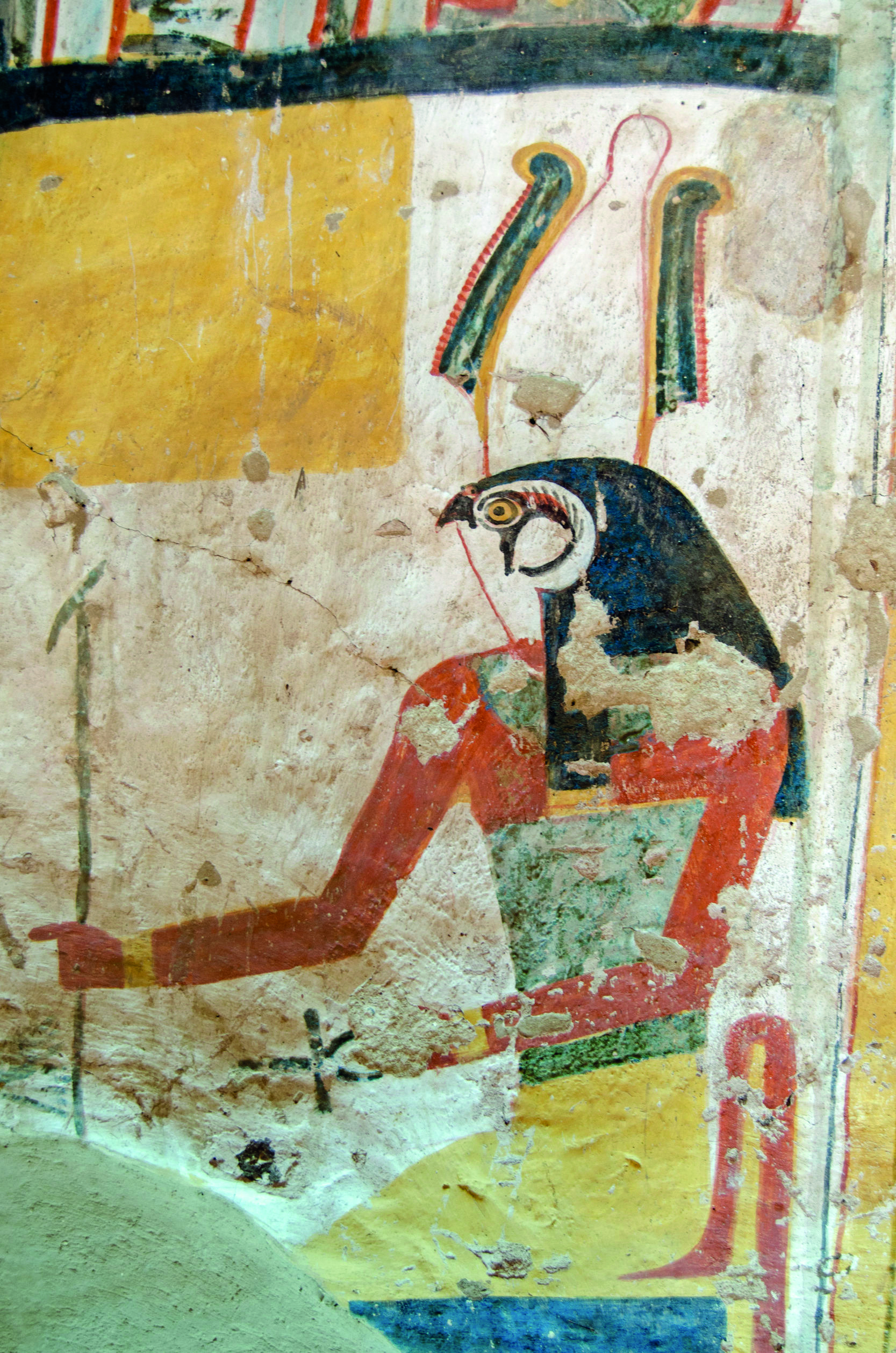
Ancient Egyptian wall painting of the falcon-headed god Horus. Inner wall of the Tomb of Amenemonet, priest of Ptah-Sokar from the Ramesside Period, Thebes, Luxor, Egypt.
The symbolism of the eye was not confined to Egypt, of course. Everywhere in the ancient world it was feared and revered and today it still remains a potent esoteric symbol. It even appears on the currency of the United States. Its enduring appeal remains, not just as a multi-semantic symbol but also in its aesthetic design that is a testament to Egyptian art and that will ensure its continued use in future.
Footnotes
- Bob Brier, Ancient Egyptian Magic, Quill New York, 1981, p.121. Bibliography Richard Wilkinson, Reading Egyptian Art, Thames & Hudson, 1992. Maria Carmela Betro, Hieroglyphics, Abbeville Press, 1996. Bob Brier, Ancient Egyptian Magic, Quill New York, 1981. Anthony Stevens, Ariadne’s Clue: A Guide to the Symbols of Humankind, Allen Lane, 1998. Barbara Watterson, Gods of Ancient Egypt, Sutton, 1996.