
Mount Kailash
By Juan Jimenez-Velasco | Feb 06, 2023
This is an extract from The Rosicrucian #91 (Feb, 2023).
There is no other mountain like the Kailash (Kang-Rimpoché – Lord of the Snows). For countless generations, the devout have followed old worn- out tracks into the Himalayas to circle this most sacred of all mountains in the desolate fastness of Asia.
I don’t think there exists anywhere in the world a sight so magnificent, so overwhelming, as the Himalayas. The sight of those giants of rock, snow and ice is an ongoing invitation to rise to the impregnable heights of one’s deeper self. No-one can ever forget a sunset in the Himalayas when the mountain is dressed in red, violet and purple. We feel infinitely small before the supreme Darshan, a vision of gods on earth. In those moments, all nature seems to explode in a climax of light, life and love. And so do we! In silence, we can but blend with that symbol of the unexplored, inaccessible summits of the self. In no other place can the presence be felt so close, the invisible overpowering presence of Divinity that, with its loving protection, watches over the many stages of human evolution.
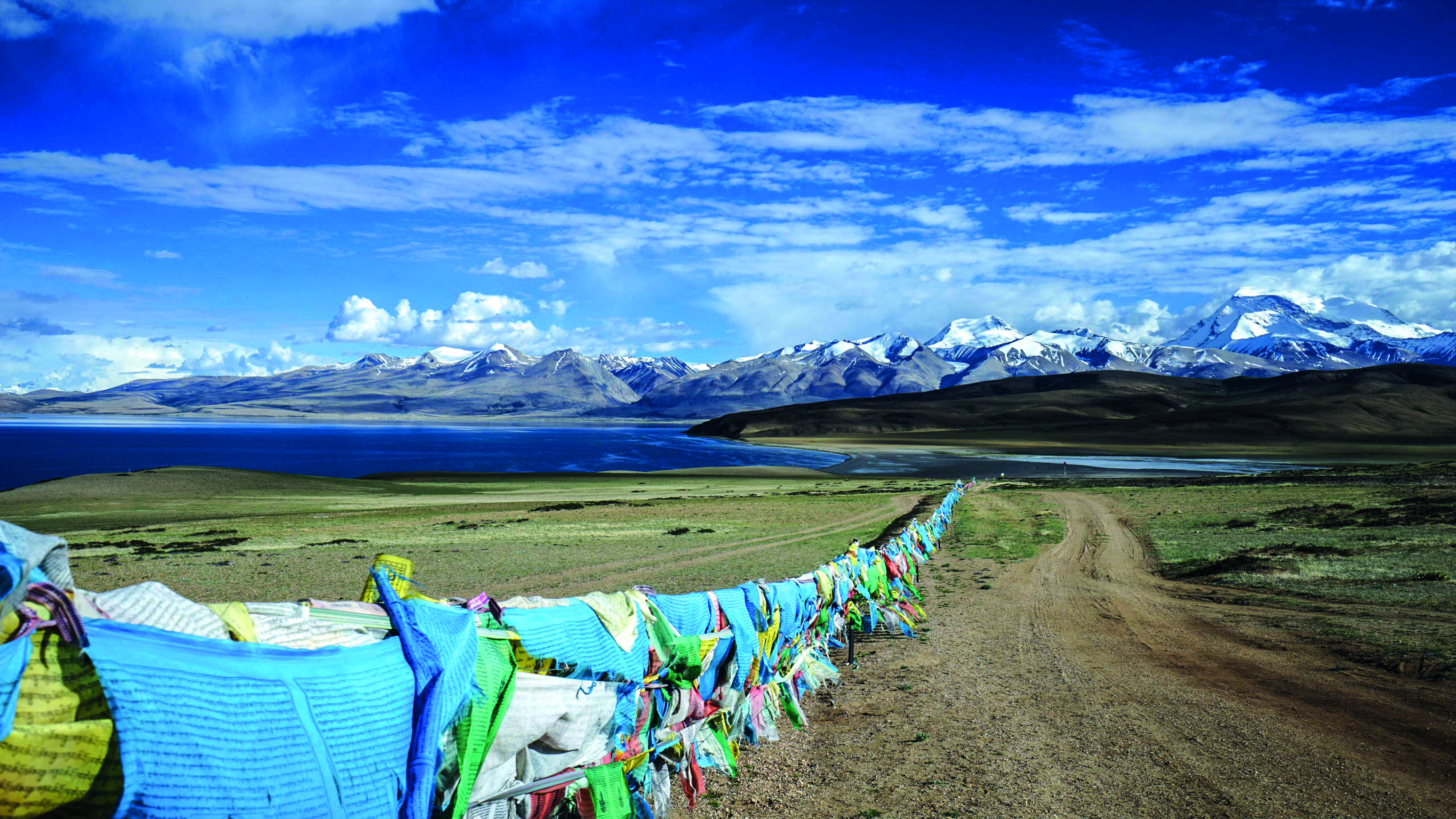
Pilgrims take a ritual bath in Lake Manasarovar before undertaking their journey.
The inhabitants of those holy regions do not experience the pleasure that westerners have in climbing mountains. To them, this mountain fastness is the abode of spirits, gods and demons, of semi-human powers and nefarious beings. To those who are spiritual, the value of the Kailash does not come from the statistics of its height, which is so important to those who wish to conquer summits, but from its nature, its exceptional character. Just as they would never dare tread on a holy talisman, the religious Tibetans would never dare to climb a holy mountain. Instead of conquering the mountain, they seek to be conquered by it. There are many difficult and dangerous adventures but the conquest of oneself remains the hardest, most heroic and most silent of quests.
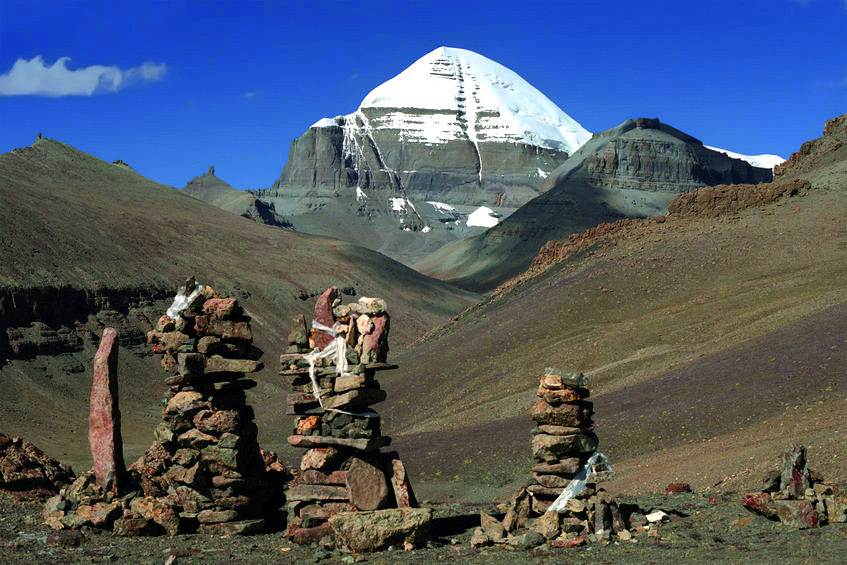
Small cairns of stones left by pilgrims.
Of all the mountains of Tibet, the fame of the holy Kailash has spread throughout Asia. There is no other mountain like it: Kang-Rimpoché, the Lord of the Snows, that forms the axis of two great civilisations, India and China. Both for Hindus and for Tibetan Buddhists, it is the centre of the universe, the land of absolute peace, the throne of Shiva, the abode of the gods, the wise and the immortals.
Twenty five years ago, an expedition led by my dear friend and sensei Michel Rivert left Berlin for the Forbidden Territory of Tibet. Our goal was not to climb mountains, but—after travelling over 6,000 miles and crossing the forests of northern India and then another 1,000 miles of desert to reach the Holy Mountain, the Kailash—we were intent on carrying out the ancient ritual of walking around the throne of the gods, the Parikrama. This involves going around the Holy Mountain, travelling always from left to right, along a path of some 35 miles. Before beginning this pilgrimage, the most holy of all that exist, we had to take a ritual bath in Lake Manasarovar, which afforded us the merits necessary for the exacting experience of reaching 14,500 feet on the Parikrama. The entire area was dotted with small cairns of stones carefully carved by pilgrims who had come to this magical land from all over Asia, often putting their very lives in danger. The traditional prayer of the Tibetans could be read carved in stone: OM MANI PADME HUM, ‘Hail to the jewel of the lotus.’
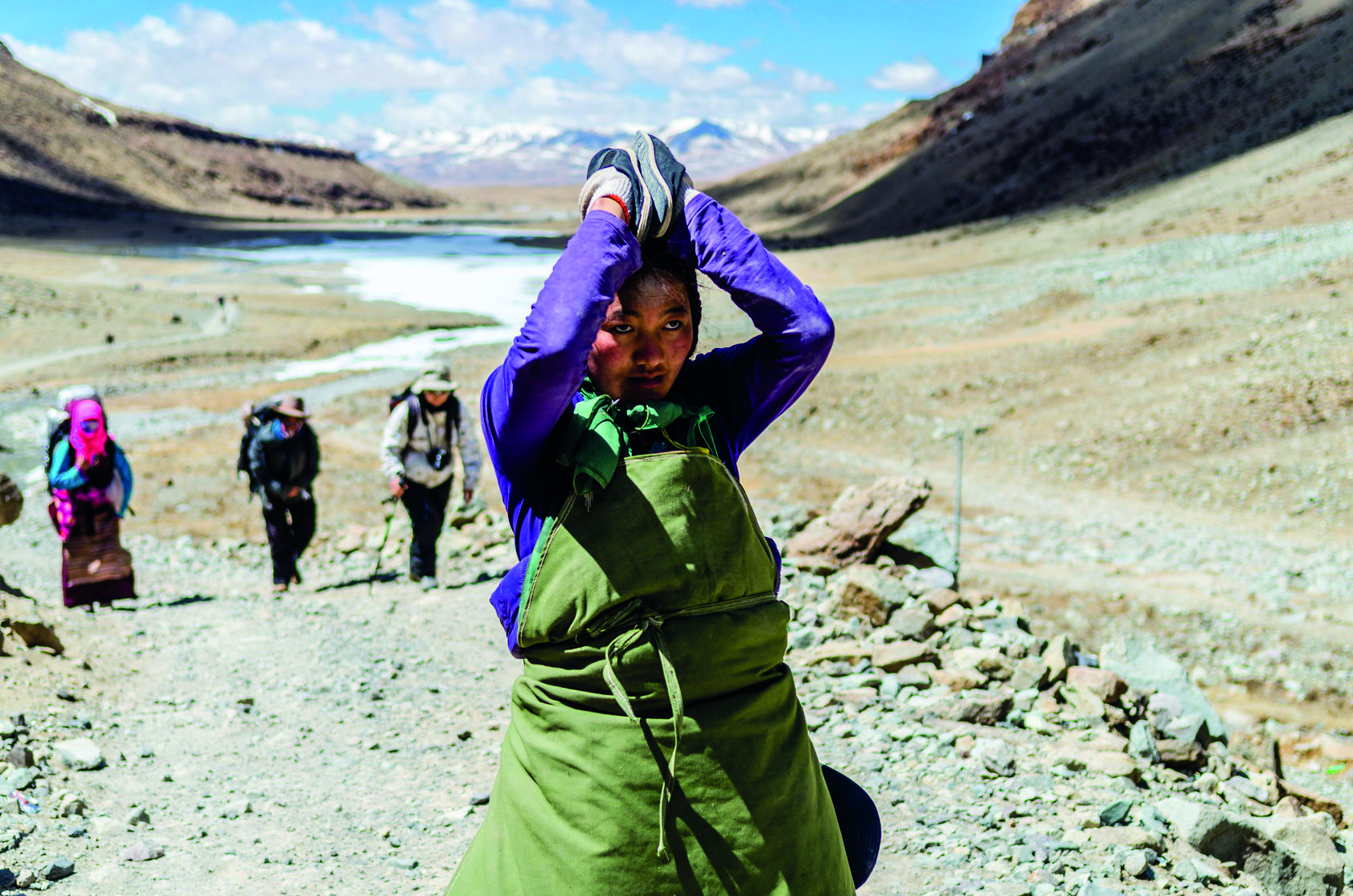
Tibetan woman performing body-length prostrations at intervals throughout her circumambulation of Kailash.
I could never describe in words the joy we felt when we saw for the first time the frozen summit of the Kailash after long, hard weeks of exhaustion and austerity. All our past suffering melted away before the sight, or rather, the contemplation of the Holy Mountain. Knowing that we had reached the holiest place on Earth brought us an indescribable feeling of happiness. The shadows, the darkness and the bad memories dissipated, just as the mist disappears under the caress of the benign rays of the awakening of the soul. We had been told that in these lands one’s mental faculties were elevated and that a person’s sensitivity became infinite; that close to the Kailash mysterious voices could be heard and visions and revelations were to be seen; that the obstructions to thought faded away and all that was dark inside oneself turned to light. Other legends spoke (and we heard it from Tibetan lips) of the presence of supra-human spirits who help pilgrims in the ritual of walking around the mountain. Legends they may have been or perhaps the hidden desire of the collective, unconscious mind; but it is true that this is a strange land, unique in all the world, a mysterious and terrible land but infinitely fascinating. At the foot of the Holy Kailash one cannot avoid the profound feeling that one is before something sacred, before a symbol of the virgin, unexplored lands of the interior of humankind.
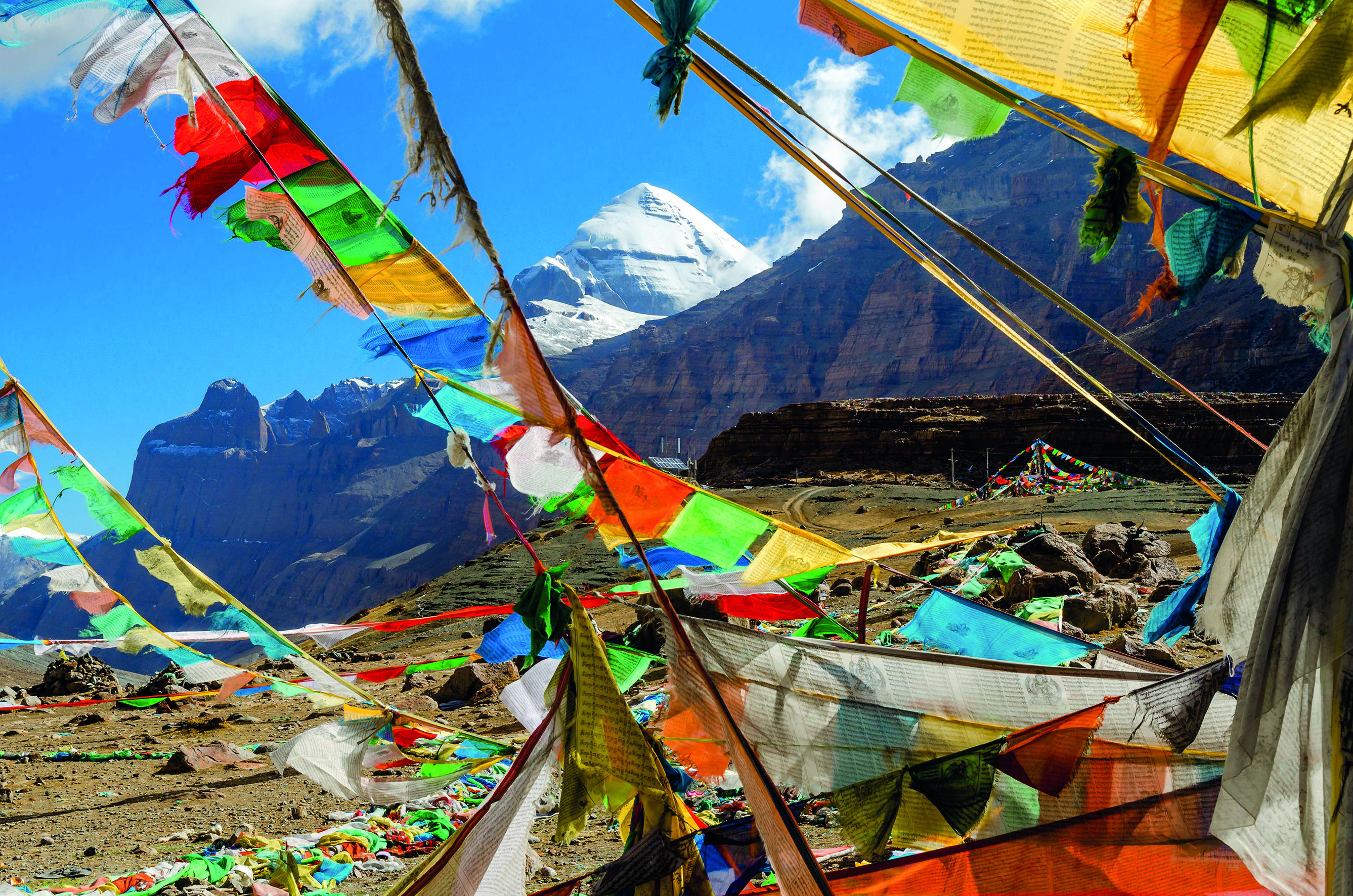
Mount Kailash, Tibet, South face.
To the people of the east, karma is the law of cause and effect. The errors or otherwise in life generate positive or negative reactions in this or a following life; all of which cause an eternal process of reincarnation in which we purify ourselves by compensating our wrongful deeds with benign acts. Every thought, every word, every act is the seed of subsequent manifestations which tend to show us the correct path to freedom. In the west, we have still not realised the importance and the evidence of this natural law, and we understand it even less in its fundamentally creative purpose. On the contrary, submerged still in the ambiguity of the concept of good and evil, we interpret this basic law of the universe as a punishment or as a reward. And it is true that the extensive literature on the subject has not helped to clarify to any great extent this teaching. Whether we want to accept it or not, the law exists and nothing and no-one can escape from its cycle of actions and reactions. Nevertheless, far from being a fatal principle, karma can be voluntarily compensated and even neutralised.
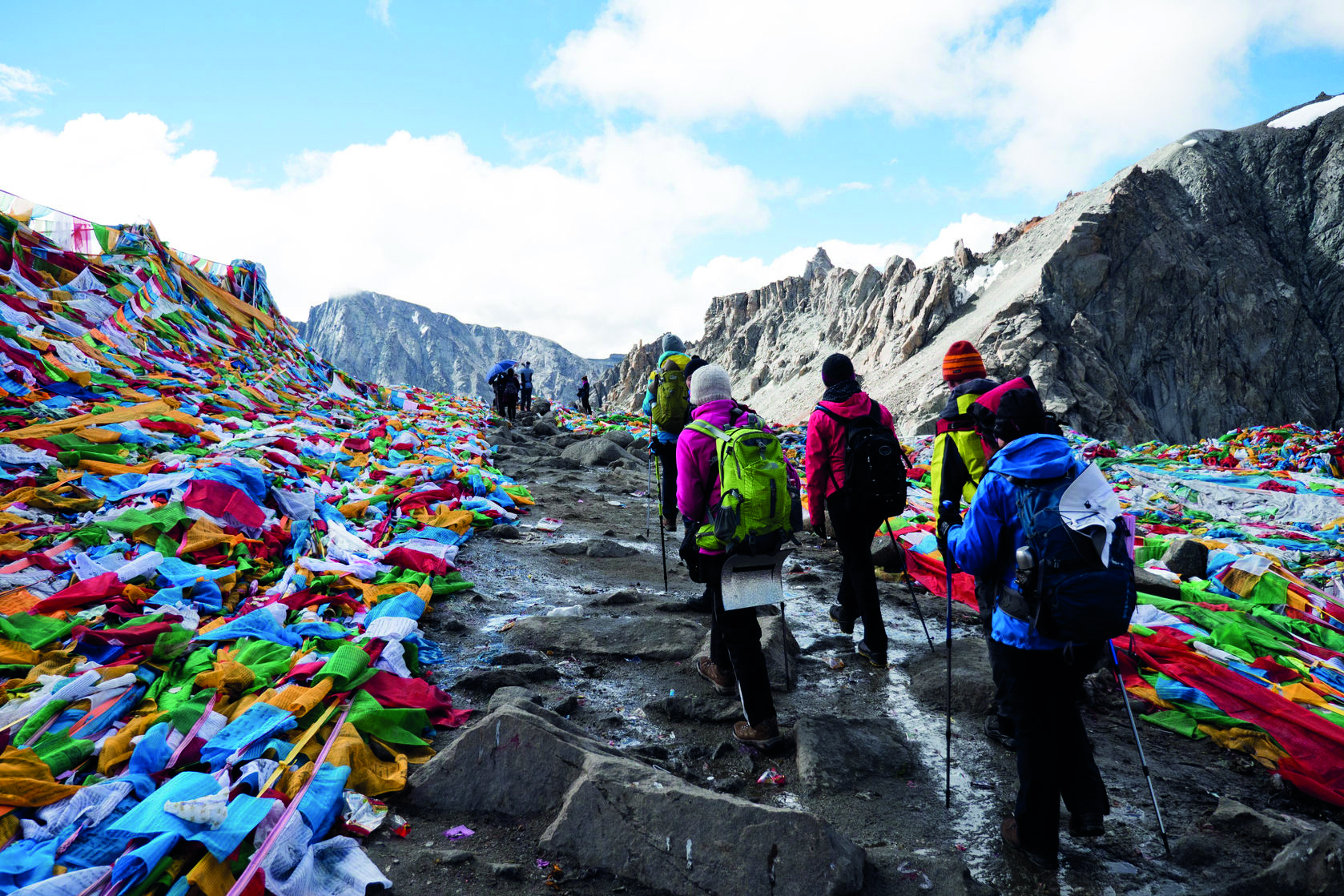
Tradition says that a single circuit around the Kailash purifies the karma of a whole lifetime, and ten times around the Holy Mountain will purify the karma of numerous existences. One hundred and eight ritual circuits of the mountain will ensure freedom in this lifetime. It is certainly true that this ancestral rite is a very tough ordeal, and in order to carry it out it is necessary to undertake (and I can bear witness to this) a superhuman mental and physical effort and pay a high price in enormous personal suffering. But all the ways to freedom and knowledge demand this from us, do they not? Let us follow them to heaven.
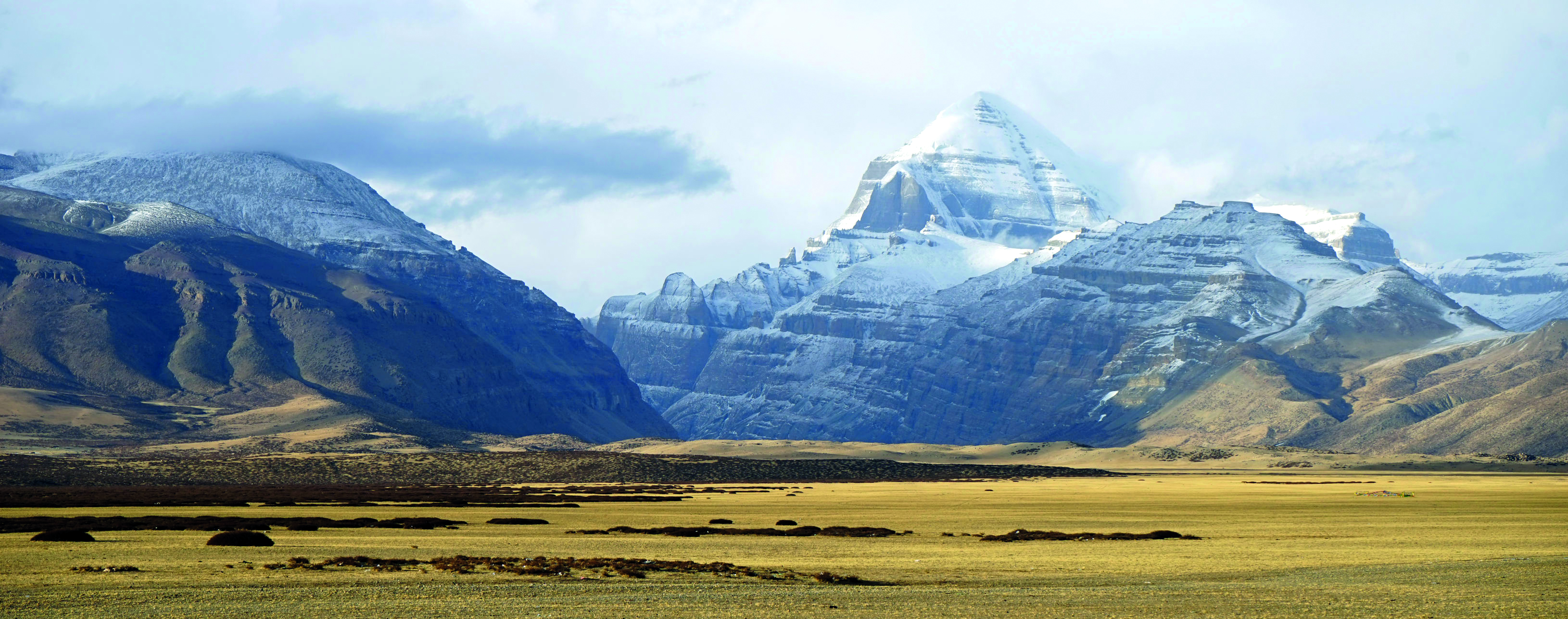
High above a glacial valley leading off from Kailash, pilgrims pause at a monastery to view the sacred mountain. In the vastness of Tibet, they are but the latest to pass this way, just a few of the millions who have made their way, painstakingly, from monastery to monastery, from century to century in search of the sacred. With the rigours of a devotion and tenacity which few in the Western world could even imagine, it is likely that at least some of these pilgrims reached their goal of Illumination and a final release from the cycle of birth and rebirth in material reality.