
Zen: A Brief History
By Bill Anderson | Aug 01, 2022
This is an extract from The Rosicrucian #89 (Aug 2022)
Zen Buddhism is not a religion in quite the same manner as the word ‘religion’ is interpreted in the West. It is a way of life, a journey which guides the practitioner from unawareness to awareness. The word ‘religion’ in the West is almost exclusively associated with the concept of an all-knowing, all-powerful, all-seeing supreme deity called ‘God.’ It is not a mere cerebral concept though, for God in the orthodox liturgy of the Judeo-Christian-Islamic lineage personally intervenes in the daily affairs of His creation and specifically intervenes in the lives of humans. This is where Buddhism in general, and Zen in particular, part company with the predominantly Western religious tradition.
Buddhism is often referred to as a ‘dharma’, a word with no direct, single Western equivalent, though with many associated meanings which describe aspects of this single word. In the Vedic-related religions of Hinduism, Buddhism, Sikhism and Jainism, dharma means living in accordance with ‘Ṛta’ (Sanskrit ṛtaṃ, meaning fixed order, [supreme] reality, rule, [divine] law, truth, properly joined), which in the West has its closest analogy with the ancient Egyptian concept of living in accordance with ‘Maat’, a word meaning something approximating ‘right order’, ‘truth’ and ‘right way’ (of living). Ṛta in turn emerges from the Proto-Indo-European morpheme ‘ṛt’ which has descended, for example, into the ancient Greek Sophists’ understanding of ‘arete’, meaning ‘quality’, and into English words like aristocrat, art, rhetoric, worth, rite, ritual, wright, right (handed), and right (correct).
The Buddhist ‘right way of living’ encompasses a variety of traditions, beliefs and, most importantly, practices that are largely based on the life philosophy and teachings of a person known as Siddhartha Gautama or, more commonly in the West, as the Buddha, ‘the awakened one.’ In Buddhist tradition, this ‘awakened person’ lived and taught in the northern and eastern parts of the Indian subcontinent sometime between the 6th and 4th Centuries BCE. He is recognised by Buddhists as an ‘awakened’ or ‘enlightened’ teacher who shared his insights to help sentient beings to end their suffering through the elimination of ignorance and craving. The ultimate goal of Buddhism is the attainment of the sublime state of Nirvana by practising the Noble Eightfold Path, also known as the Middle Way.
When I hear the word ‘Zen’, I automatically think of the cultured refinement of Japanese traditions. But I know as well that Zen Buddhism has a pedigree that can be traced back through many lands: China (first and foremost), Korea, Afghanistan, Pakistan and India, to name a few. Buddhism may have begun in India but it was disseminated along the Silk Road, which is the name given to a series of interlinked trade and cultural transmission routes. These routes were central to cultural interaction through different regions of the Eurasian continent, connecting the West and East by linking traders, merchants, pilgrims, monks, soldiers, nomads and urban dwellers from China and India to the Mediterranean Sea and Rome during various time periods.
The Silk Road
Extending some 4,000 miles (6,437 kilometres), the Silk Road was so-named because of the lucrative trade in Chinese silk carried out along its length, beginning during the Han dynasty (206 BCE – 220 CE). The Central Asian sections of the trade routes were expanded around 114 BCE, largely through the missions and explorations of Chinese imperial envoys. Trade on the Silk Road was a significant factor in the development of the civilisations of China, the Indian Subcontinent, Persia, Europe and Arabia, opening long-distance, political and economic interactions between the civilisations.
Although silk was certainly the major trade item from China, many other goods were traded as well. Religions, syncretic philosophies and various technologies, as well as diseases, also travelled this route. In addition to economic trade, the Silk Road served as a means of carrying out cultural trade among the several major civilisations that existed along its network. So, as silk travelled west, religions such as Manichaeism, Buddhism and Christianity travelled east, and what we today consider purely Eastern or purely Western has since antiquity always had elements of both hemispheres, at least to some extent.
Buddhism entered China via the Silk Road, beginning in the 1st or 2nd century CE. The first documented translation efforts by Buddhist monks in China (all non-Chinese) were in the 2nd century CE, possibly as a consequence of the expansion of Kushānshahr, the Greco-Buddhist Kushān Empire, into the Chinese territory of the Tarim Basin, dominated by the Taklamakan Desert in what is now the Xīnjiāng Uyghur Autonomous Region of China. The Tarim Basin was a strategic melting pot of Silk Road traffic, a hub of interchange of both goods and ideas, philosophies and religious beliefs. And of course the several Tocharian languages, the easternmost group of Indo-European languages, were once spoken there. Besides Tocharian, various Eastern Iranian Khotanese Scythian dialects were also used.
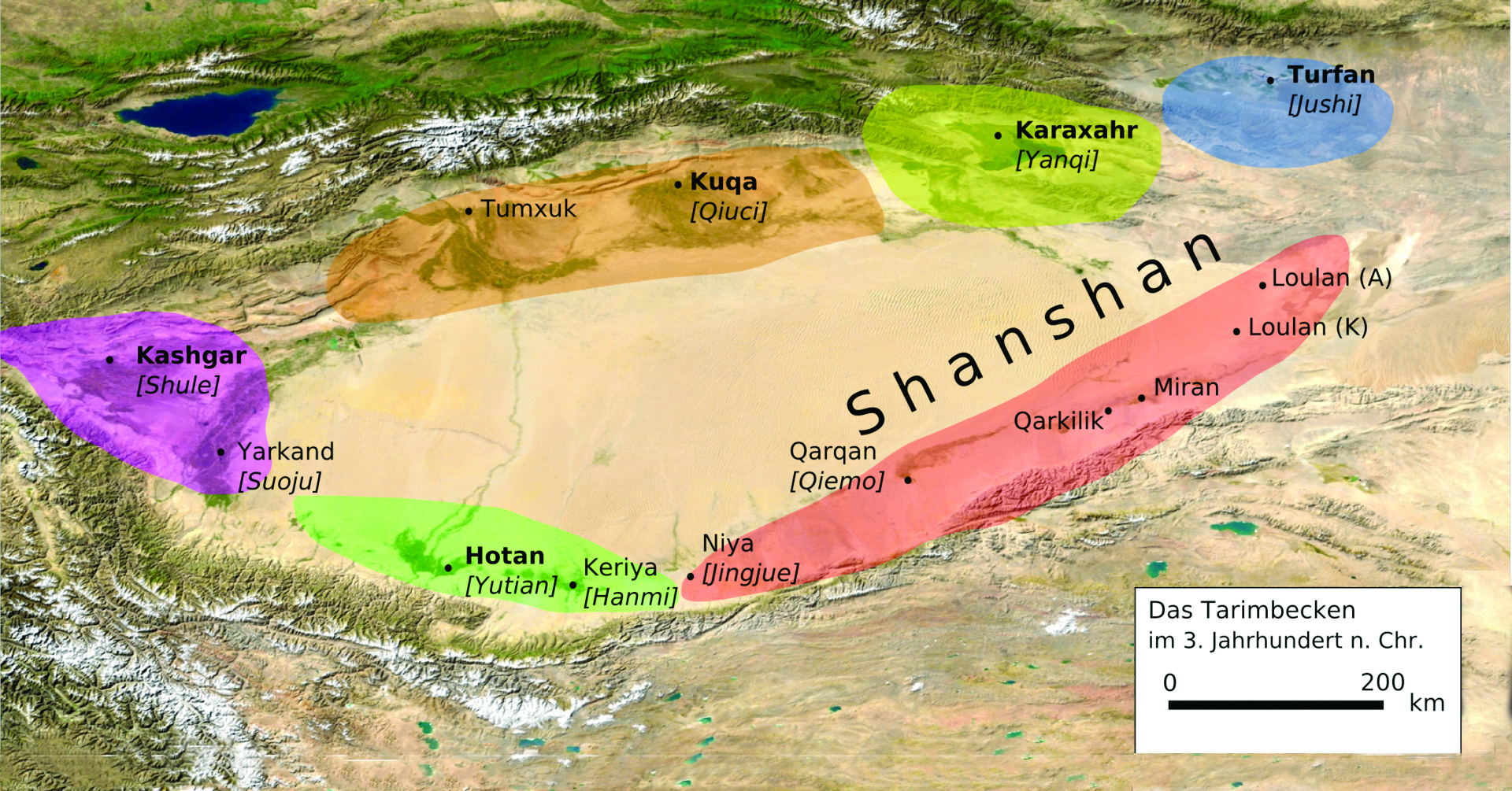
Map of the Tarim Basin in the 3rd century CE showing the various states surrounding the high Tibetan plateau and desert through which the Silk Road passed.
Kushānshahr and Gandhara
Direct contact between Central Asian and Chinese Buddhism continued throughout the 3rd to 7th century, well into the Táng Dynasty. From the 4th century onward, with Făxiăn’s pilgrimage to India (395–414), and later Xuánzàng (629–644), Chinese pilgrims started to travel by themselves to northern India, their closest source of Buddhism, in order to gain access to original scriptures. Much of the land route connecting northern India with China at that time was ruled by the Buddhist Kushān Empire, with its heart in the kingdom of Gandhara in its western section. During these centuries, the combination of Indian Buddhism with Western influences (Greco-Buddhism) gave rise to the various distinct schools of Buddhism in Central Asia and China.
Greco-Buddhist art is the finest artistic manifestation of Greco-Buddhism, a cultural syncretism between Classical Greek culture and Buddhism, which developed over a period of close to 1,000 years in Central Asia, between the conquests of Alexander the Great in the 4th century BCE and the Islamic conquests of the 7th century CE. This syncretic art is characterised by the strong idealistic realism and sensuous description of Hellenistic art and the first representations of the Buddha in human form.
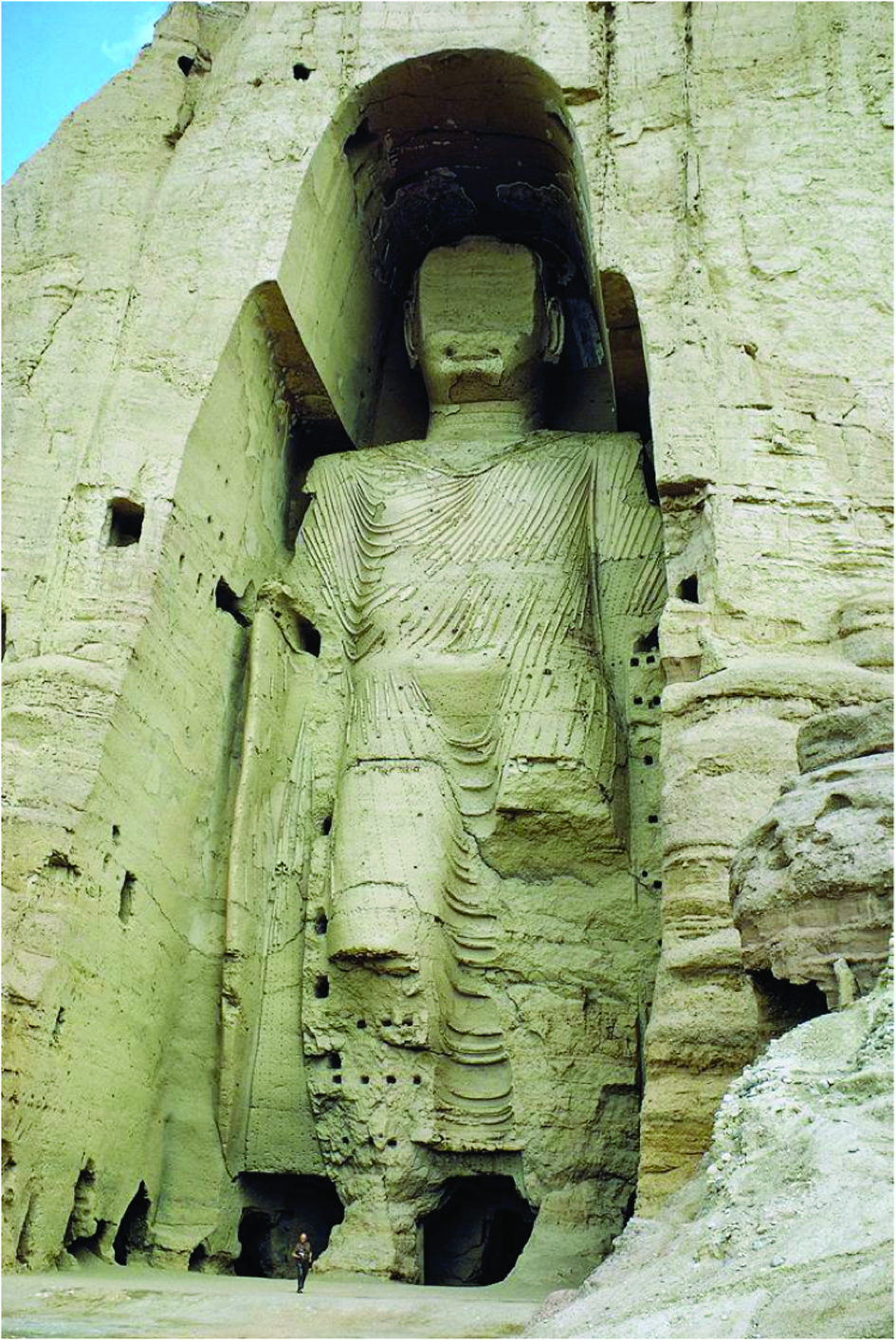
One of the Bamiyan Buddhas in Afghanistan (Kushān Empire) before their destruction.
Greco-Buddhist art depicts the life of the Buddha in a visual manner, probably by incorporating the real life models and concepts which were available to the artists of the period. The Bodhisattvas are depicted as bare-chested, bejewelled Indian princes, and the Buddhas as Greek kings wearing the toga-like himation. The buildings in which they are depicted incorporate Greek style with the ubiquitous Indo-Corinthian capitals and Greek decorative scrolls.
The Kushān Empire was originally formed in the early 1st century CE in the territories of the former Greco-Bactrian Kingdom around the Oxus River (nowadays called the Amu Darya), and later based near Kabul, now the capital of Afghanistan. The Kushāns, an Indo-European people of possible Iranian or Tocharian stock, spread out from the Kabul River Valley to encompass much of the Indo-Greek Kingdom, one of the successor states of Alexander the Great, from which they took their first official language, the Bactrian alphabet, Greco-Buddhist religion, coinage system and art. They absorbed the Central Asian tribes that had previously conquered parts of the northern central Iranian Plateau, once ruled by the Parthians and reached their peak under the Buddhist emperor Kanishka (127–151 CE), whose realm stretched from Turfan in the Tarim Basin in the West to Pataliputra, near Patna in Bihar state on the Ganges Plain in the East. They therefore controlled the central part of the Silk Road.
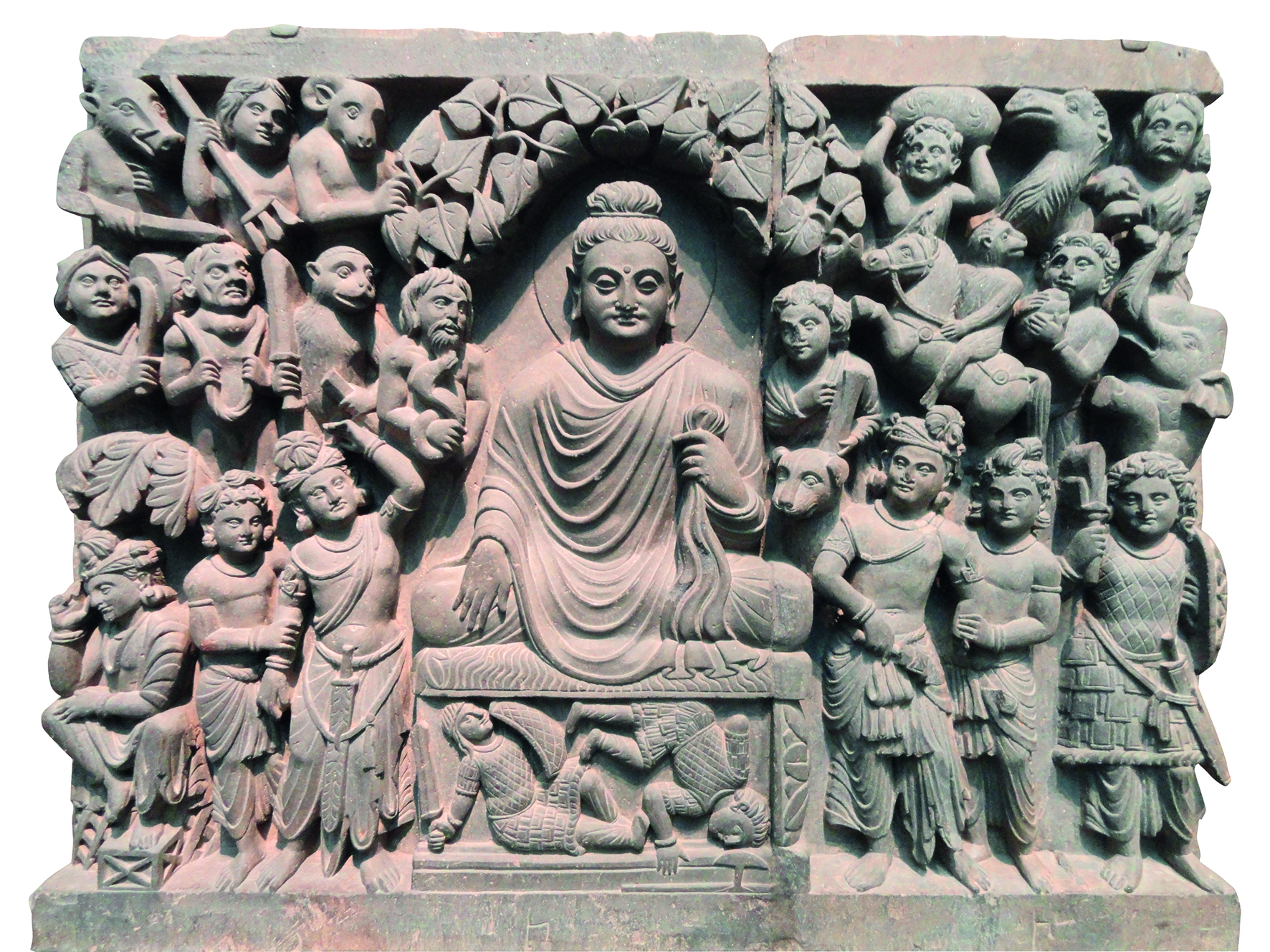
An example of Greco-Buddhist art, Kushān Empire, late 2nd to early 3rd century CE.
The Kushāns had diplomatic contacts with the Roman Empire, Sassanid Persia, the Aksumite Empire of Ethiopia and the Han Dynasty China. While much philosophy, art and science was created within its borders, the only textual record we have of the empire’s history today comes from inscriptions and accounts in other languages, particularly Chinese.
It is in the Kushān Empire that we find the genesis of the main branch of Buddhism: Mahāyāna. The Mahāyāna tradition is the largest branch of Buddhism existing today, having 53% of all Buddhists, compared to 36% for the Theravāda and 6% for the Vajrayāna. Although Mahāyāna means ‘Great Vehicle’, it also refers to the path of the Bodhisattva as s/he seeks complete enlightenment for the benefit of all sentient beings.
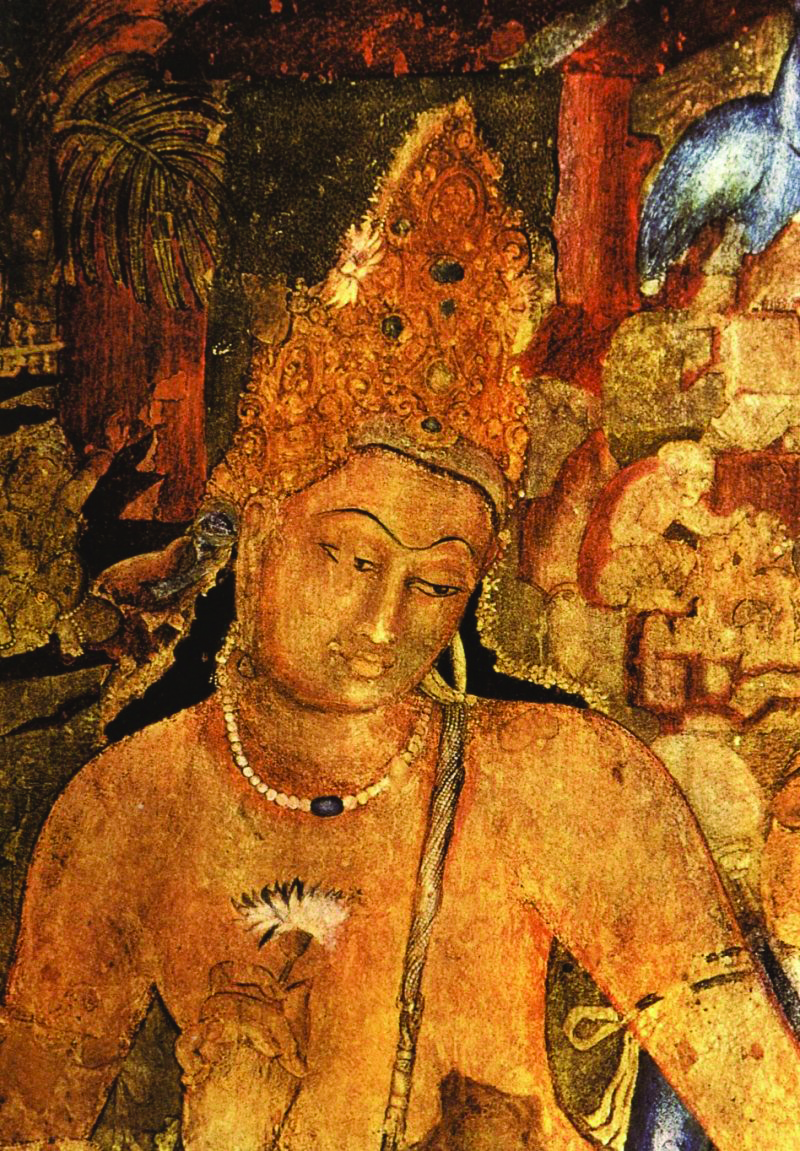
Indian cave wall painting of Avalokiteśvara. Ajantā Caves, 6th century CE.
Mahāyāna Buddhism
In the course of its history, Mahāyāna Buddhism spread from India to various other Asian countries such as Bangladesh, China, Japan, Vietnam, Korea, Singapore, Taiwan, Nepal, Sri Lanka, Tibet, Bhutan, Malaysia and Mongolia. Major traditions of Mahāyāna Buddhism today include the following:-
- Zen: most popularly known from Japan, but the word originates from the Chinese word Chán.
- Pure Land: called Jōdo bukkyō in Japanese, Jìngtŭzōng in Chinese, and Jeongtojong in Korean.
- Lotus Sutra: Tendai in Japanese, Tiāntái in China, and Cheontae in Korea.
- Nichiren: Hokke-kei Bukkyo in Japanese.
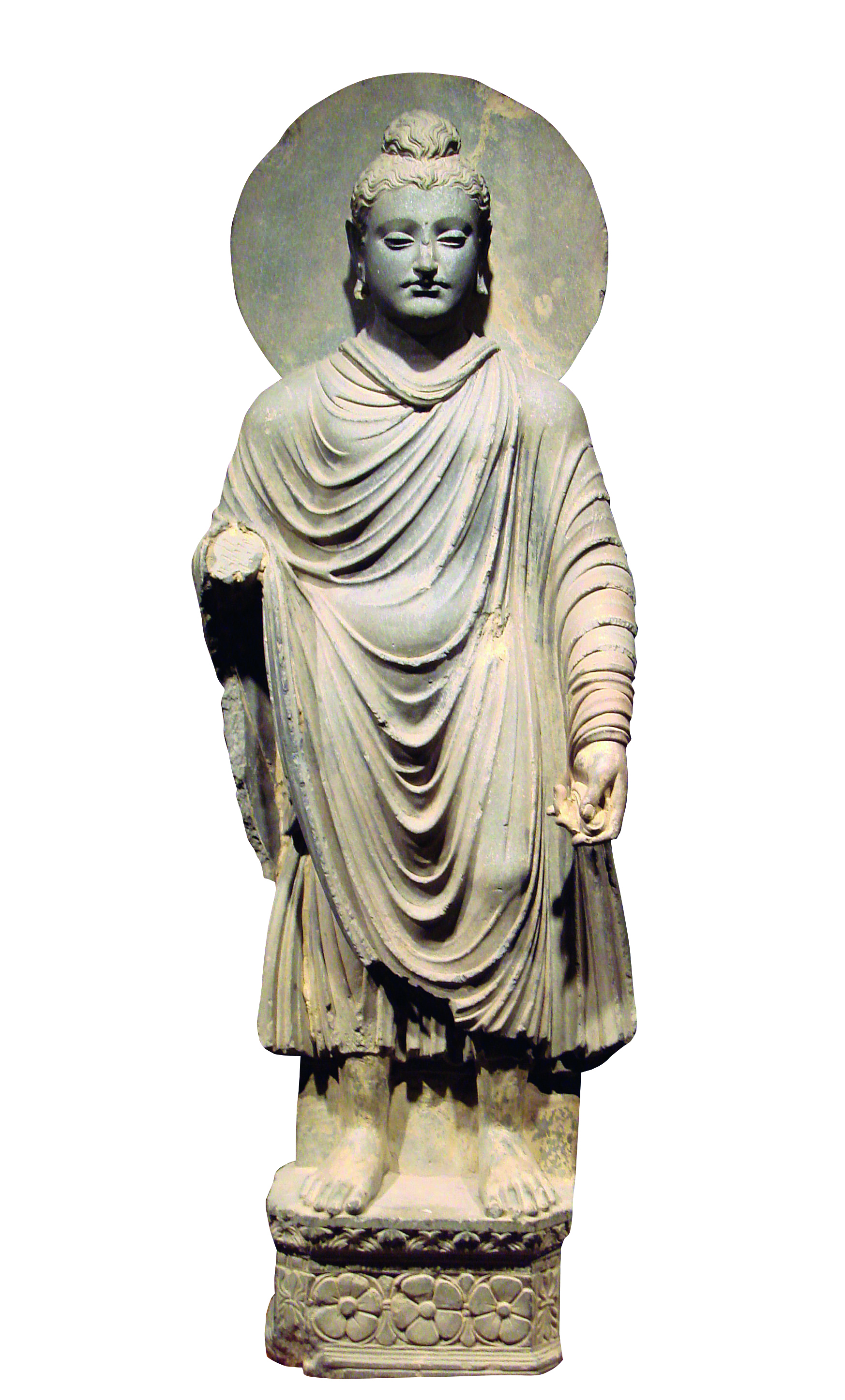
One of the first representations of the Buddha wearing the Greek himation. Gandhara, 1st-2nd century CE.
The Heart Sūtra (Sanskrit: Prajñāpāramitā Hrdaya) is a famous sūtra in Mahāyāna Buddhism. Its Sanskrit title means ‘The Heart of the Perfection of Transcendent Wisdom.’ This sutra is often cited as the best-known and most popular Buddhist scripture of all. The Chinese version is frequently chanted (in the local pronunciation) by the Chán (Zen/Seon) school during ceremonies in China, Japan, Korea and Vietnam. It is also significant to the Shingon Buddhist school in Japan, whose founder Kūkai wrote a commentary on it. And in various Tibetan Buddhist monasteries it is studied extensively.
Zen began to emerge as a distinctive school of Mahāyāna Buddhism when the Indian sage Bodhidharma (ca. 470-543 CE) taught at the Shàolín Monastery in China. Because of his ground breaking work, Bodhidharma is called the First Patriarch of Zen. The word Zen is originally derived from the Sanskrit word dhyāna, meaning ‘meditation.’ As practised in China (Chán), Korea (Seon) and Japan (Zen), Zen is today a quite specific form of Buddhism focusing overwhelmingly on a single outcome: true meditation. Zen places far less emphasis on scriptures than other forms of Buddhism and deals instead with a practical method of gaining spiritual breakthroughs and elevated awareness through the proper use of meditation.
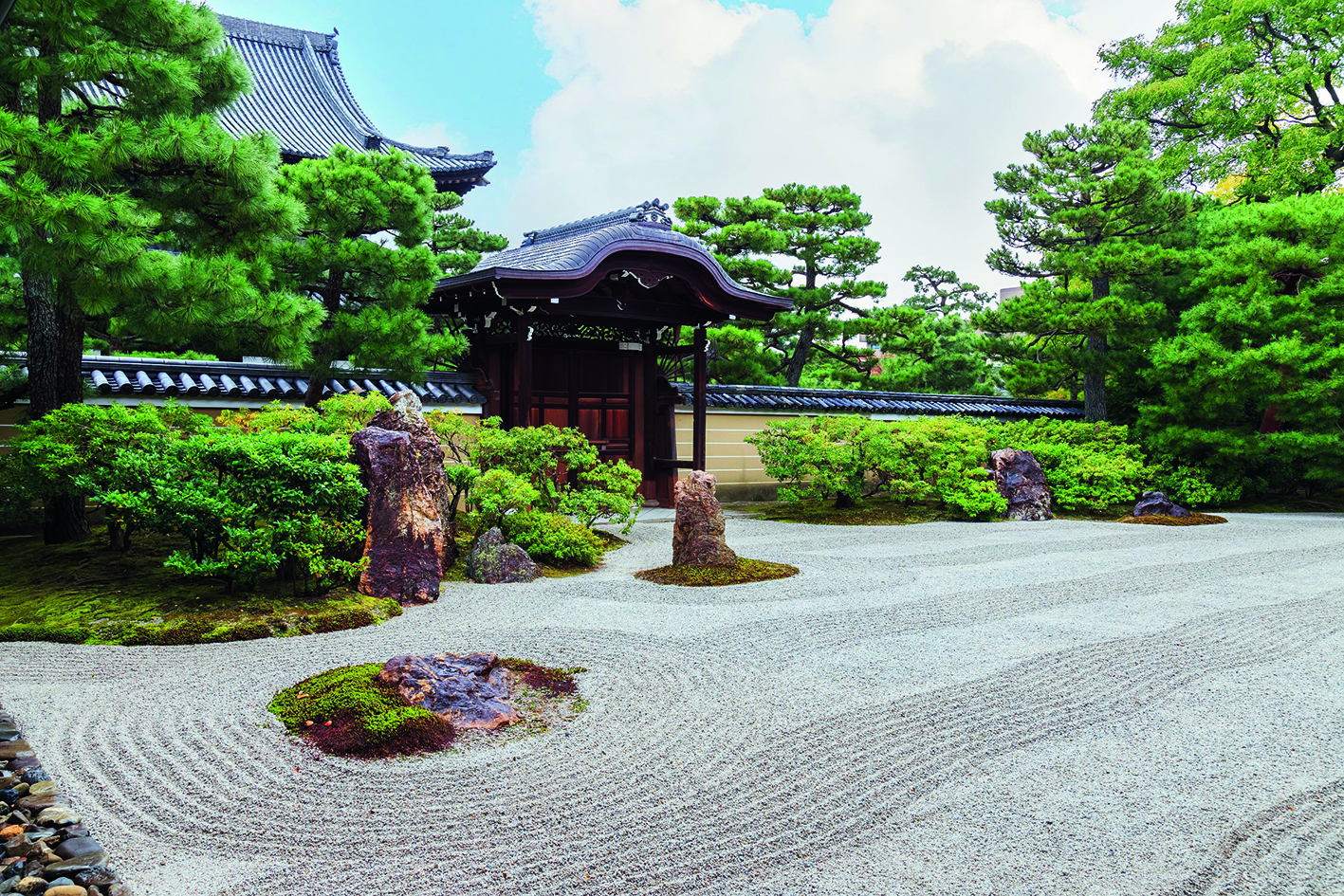
Zen garden at Kennin-ji temple in Kyoto, Japan.
Zen in China
Buddhism first reached China from India roughly 2,000 years ago, during the Han Dynasty. Han Dynasty China was deeply Confucian, and Confucianism is focused on maintaining harmony and social order in the here-and-now, with little or no thought for a ‘hereafter’ world. Buddhism, on the other hand, emphasised entering the monastic life to seek a reality beyond ordinary reality. The two world views were bound to collide, and this they soon did. Confucianism was not welcoming of Buddhism as it saw it as a dangerous and impractical upturning of the existing order of things.
Buddhism, however, found an ally in China’s other great indigenous religion, Taoism. Taoist and Buddhist meditation practices and philosophies were similar in many respects, and some Chinese took an interest in Buddhism from a Taoist perspective. Early translations of Buddhist texts from Sanskrit into Chinese borrowed Taoist terminology. Still, during the Han Dynasty very few Chinese practised Buddhism.
In south China, a kind of ‘gentry Buddhism’, stressing learning and philosophy, became popular among educated and well-to-do Chinese. The elite of Chinese society freely associated with the growing number of Buddhist monks and scholars. The dialogue between Buddhism and Taoism continued, and the Taoist influence caused the Chinese to favour Mahāyāna Buddhism.
In north China, Buddhist monks who were masters of divination became advisers to rulers of the ‘barbarian’ tribes. Some of these rulers became Buddhists and supported monasteries and the ongoing work of translating the Sanskrit texts into Chinese. This separation of north and south China caused Buddhism to develop into northern and southern schools in China.
There are six acknowledged Patriarchs of Zen in China. Under the 6th Patriarch, Huìnéng (638-713), Zen removed most of its remaining Indian trappings, becoming more Chinese and more what we now consider as being Zen. Some (although much in the minority) consider Huìnéng, not Bodhidharma, to be the true father of Zen. Huìnéng’s tenure was at the beginning of what is still called the Golden Age of Zen which can roughly be equated to China’s Táng Dynasty, 618-907. The masters of the Golden Age still speak to us through kōans and stories. Of the several distinctive schools of Mahāyāna Buddhism that had originated in China, only Pure Land and Zen survived with an appreciable number of followers despite the suppression that occurred during the later Táng Dynasty.

The Sixth Patriarch tearing a Sutra, Song Dynasty (960–1279 CE).
Seon – Korean Zen
In Korea, Buddhist temples are abundant. Many of the oldest and most famous temples are located high up in the mountains where Buddhist monks and nuns live, meditate and study. Many temples have beautiful architecture, statues, paintings and pagodas, some dating back more than 1,000 years.
Buddhism first arrived in Korea in 372 in the Goguryeo kingdom (37 BCE – 668 CE). In 374 the influential Chinese monk Ado arrived in the kingdom and so deeply impressed the king Sosurim the following year that the first two temples Seongmunsa and Ilbullansa were built by him in 375. Buddhism soon became the national religion of the Goguryeo kingdom.
A series of teachers transmitted Zen to Korea during the Golden Age. A new epoch in Korean Buddhism began in another of the three kingdoms of Korea, the Silla kingdom (57 BCE – 935 CE), with the establishment of several Zen (Seon) schools. In China, the movement towards a form of Buddhism based primarily on meditational practices began during the 6th and 7th centuries. It was not long before the influence of this new approach reached Korea, where it was known as Seon, meaning ‘meditation.’ Tension developed between the new meditational schools and those which were until then academically-oriented and which were described by the term gyo, meaning ‘learning’ or ‘study.’
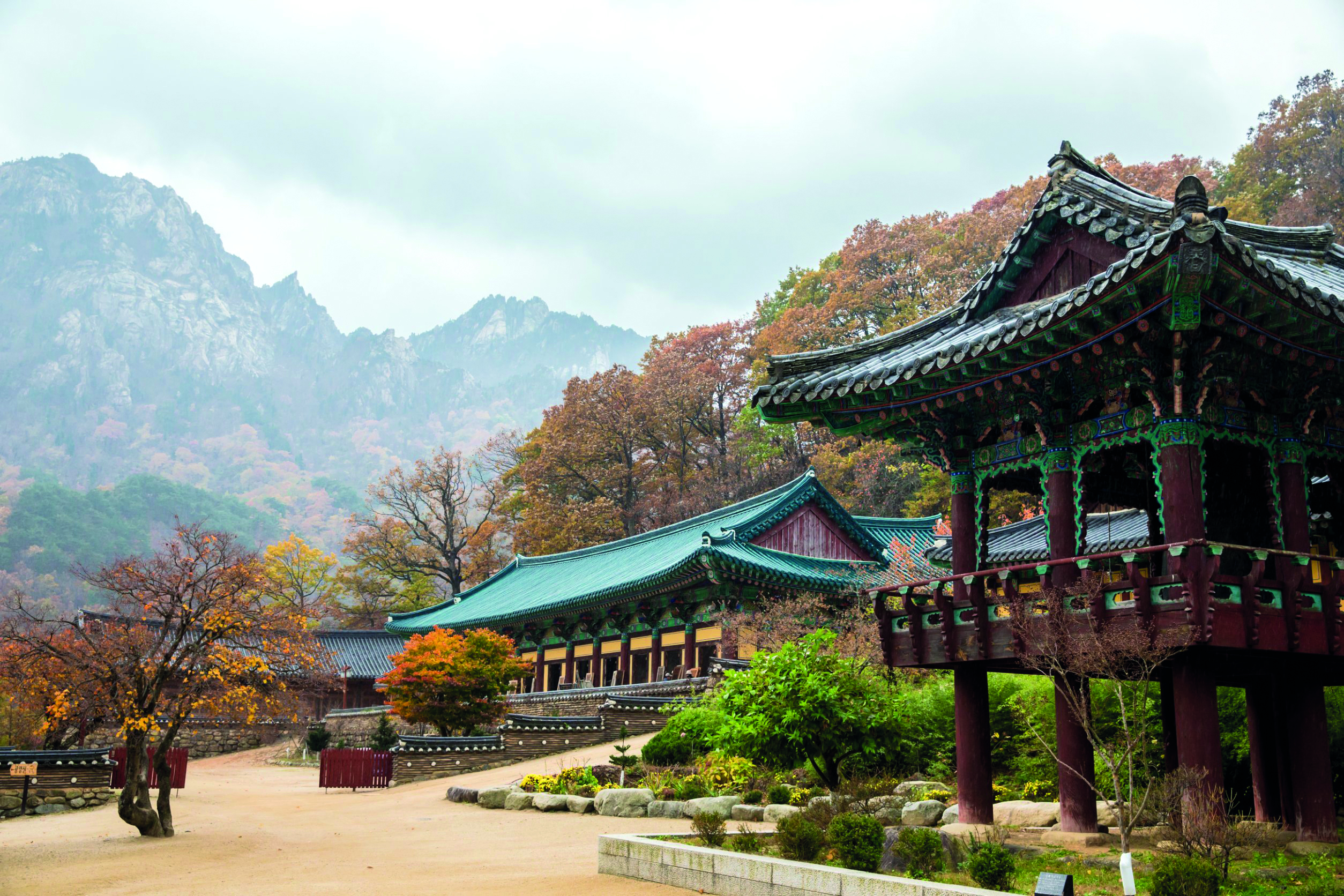
Buddhist Sinheungsa temple in Seoraksan National Park, South Korea.
Beomnang (632–646), said to be a student of the Chinese Fourth Patriarch Daoxin (580–651), is generally credited with the initial transmission of Seon into Korea. Seon was popularised by Sinhaeng (704–779) in the latter part of the 8th century and by Doui, who died in 825. From then on, many Koreans studied Zen in China, and upon their return established their own schools at various mountain monasteries with their leading disciples. Initially, the number of these schools was fixed at nine, and Korean Seon was as a consequence called the ‘nine mountains’ (gusan) school. Eight of the schools were of the lineage of Măzŭ Dàoyī (709–788), as they were established through connection with either him or one of his eminent disciples. The one exception was the Sumi-san school founded by Ieom (869–936), which had developed from the Cáodòng lineage.

The interior of a Korean Buddhist temple in the capital Seoul.
Here is a recent description of a visit to a Korean Seon temple which gives an insight into Korean temple life:
Everything was so clean: from the mountain air to the spring water that flows from stone fountains and tastes better than any fine wine from Bordeaux. And this, combined with some vigorous hiking and quiet meditation and reflection, contributed to the best nights’ sleep I have had since I was a child.
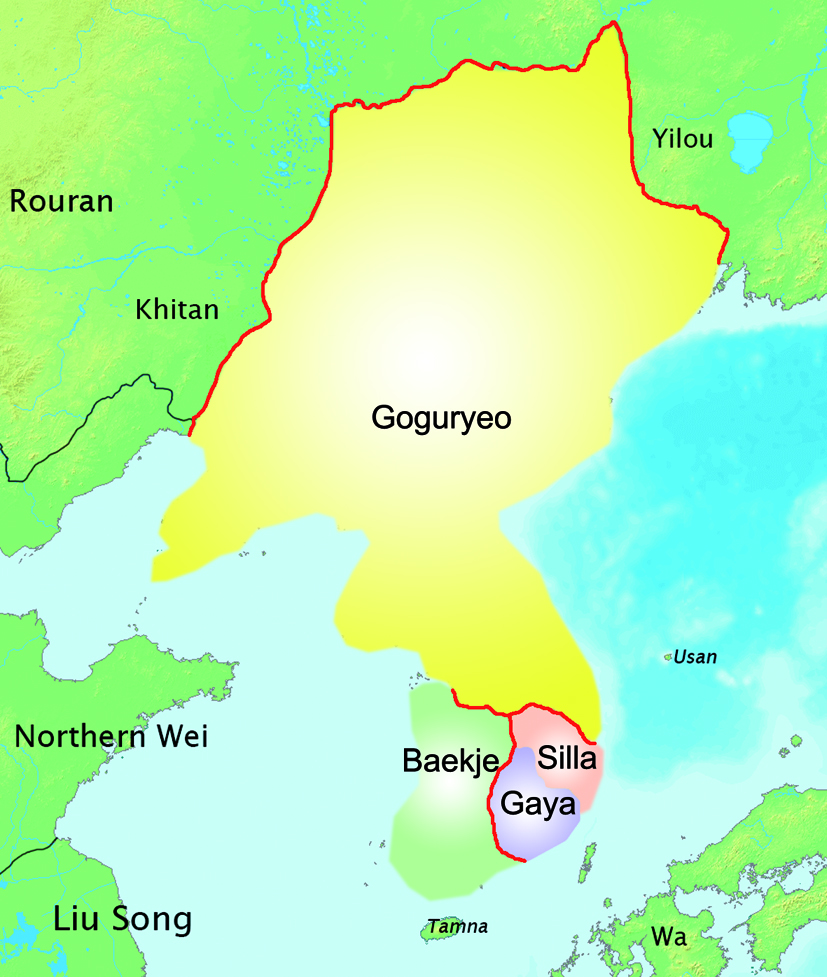
The three kingdoms of Korea: Goguryeo, Baekje and Silla. The Gaya confederacy (c. 42-532 CE) existed within the borders of the Silla kingdom but was eventually subdued and fully incorporated into it. Silla conquered parts of Goguryeo in the latter part of its history, considerably expanding its reach.
Each temple offers an early-morning chanting ceremony at 04:00, Zen meditation during the day, a tea ceremony and conversation with a monk, community work, hiking and participating in evening prayers.
I was determined to hear the early morning service, which began at 03:30, and asked my translator to make sure I awoke in time. I sat in the small, quiet temple and observed two monks bowing and chanting and three lay workers performing the 108 deep-bow ceremony which took place after the service. I made an attempt myself but was only able to perform a few deep bows.
Modern Zen and Japan
Japan is a very mountainous country, and over 70% of the country is forested, mountainous and unsuitable for agricultural, industrial or residential use. As a result, the habitable zones, mainly located in coastal areas, have extremely high population densities. Indeed, Japan is one of the most densely populated countries in the world; so, with a population of some 126 million people, space and privacy are at a premium. With this lack of privacy, the only sure way of having privacy is to reach within one’s innermost being, for only there can one truly be alone.
The paramount figure in Japanese Buddhism is Prince Shōtoku (572 – 622), a semi-legendary regent and politician of the Japanese Asuka period who served under Empress Suiko. He was a son of Emperor Yōmei and his younger half-sister was Princess Anahobe no Hashihito. Over successive generations, a devotional cult arose around the figure of Prince Shōtoku for the protection of Japan, the Imperial family, and for Buddhism. He was appointed regent (Sesshō) in 593 by the Empress. Inspired by Buddha’s teachings, he succeeded in establishing a centralised government during his rule. The Prince was an ardent Buddhist and is traditionally attributed as the author of the Sangyō Gisho, or ‘Annotated Commentaries on the Three Sutras’ (the Lotus Sutra, Vimalakirti Sutra and the Sutra of Queen Srimala). The first of these commentaries, Hokke Gisho, is traditionally dated 615 CE and therefore traditionally regarded as the first Japanese text, in turn making Shōtoku the first Japanese writer. However, it is also said that despite being credited as the founder of Japanese Buddhism, the Prince respected Shintoism and visited Buddhist temples only when done in conjunction with visits to Shinto shrines as well.
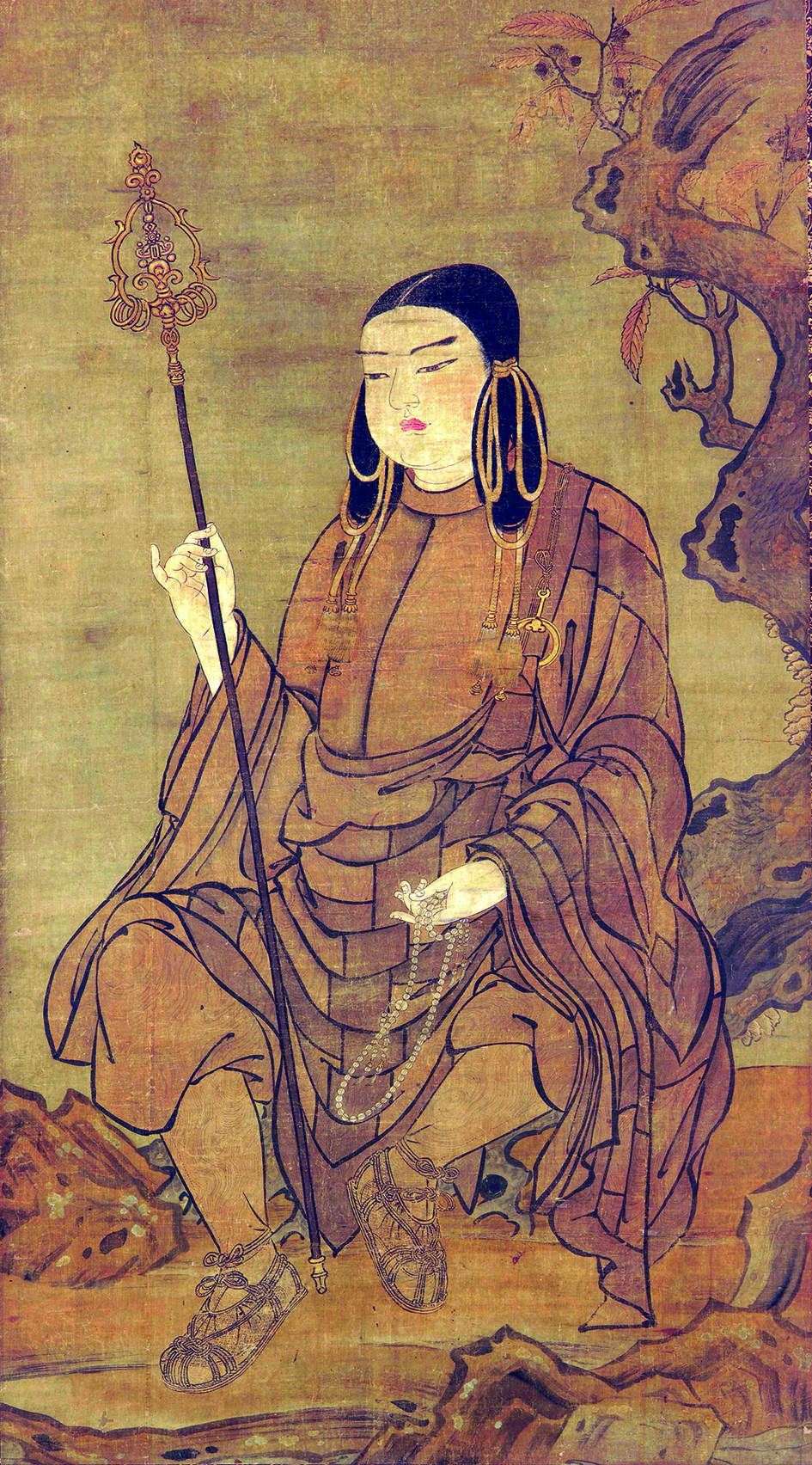
Japanese scroll painting of Prince Shōtoku at the age of 14 as a Buddhist Pilgrim.
As already stated, the central feature of Zen for at least the past millenium and a half is meditation. The tradition holds that all notions of doctrine and teachings necessitate the creation of various intellectual creations, and these in turn obscure the transcendent wisdom of each being’s innate Buddha nature. The process of rediscovery of one’s inner Buddha goes under various terms such as ‘introspection’, ‘a backward step’, ‘turning-about’ or ‘turning the eye inward.’
During seated meditation, practitioners usually assume a lotus position. To regulate the mind, awareness is directed towards counting or becoming aware of one’s breathing, and moving the focus of one’s attention to an energy centre located below the navel. Often, a square or round cushion is placed on a padded mat and is used to sit on. In other cases, a chair is used and the practice is then called seated dhyāna, zuòchán in Chinese, and zazen in Japanese.
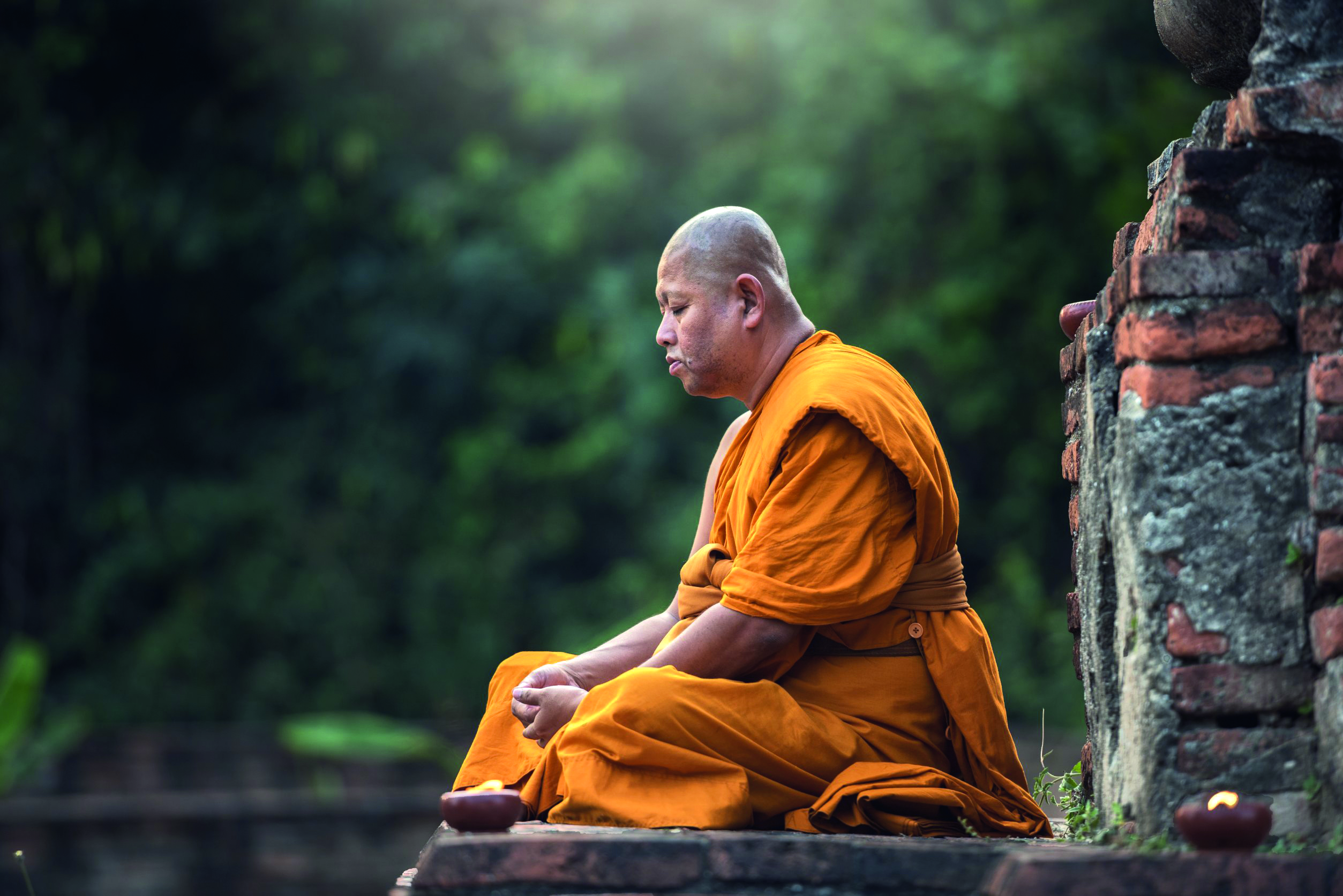
The central feature of Zen for at least the past millenium and a half is meditation.
Intensive group meditations are practised at times in some temples, and such gatherings are called Sesshin. While the daily routine may require monks to meditate for several hours each day, during the most intensive part of the practice they devote themselves almost exclusively to the practice of seated meditation. The many 30–50 minute long meditation periods are interwoven with rest breaks, meals, and short periods of work that are performed with the same mindfulness. Nightly sleep is kept to seven hours or less. In modern Buddhist practice in Japan, Taiwan and the West, lay students often attend these intensive practice sessions, which are typically 1, 3, 5 or 7 days in length.
At the beginning of the Chinese Sòng Dynasty (960-1279), use of the kōan method became popular. A kōan, literally a ‘public case’, is a story or dialogue describing an interaction between a Zen master and a student. These anecdotes give a demonstration of the master’s insight. Kōans emphasise the non-conceptual insight that the Buddhist teachings are pointing to. Kōans can be used to provoke the ‘great doubt’ and test a student’s inner progress.
Kōan inquiry may be practised during seated meditation (zazen), walking meditation (kinhin), and throughout all the activities of daily life. Kōan practice is particularly emphasised by the Japanese Rinzai school, but it also occurs in other schools or branches of Zen. The Zen student’s mastery of a given kōan is presented to the teacher in a private interview. While there is no unique answer to a kōan, practitioners are expected to demonstrate their understanding of the kōan and of Zen in general through their responses. The teacher may approve or disapprove of the answer and guide the student in the right direction. The interaction with a Zen teacher is central to Zen but makes Zen practice, at least in the west, vulnerable to both misunderstanding and abuse.
Zen Paradox
Paradoxes abound in Zen Buddhist teachings, almost to the point where it seems that the whole edifice upon which it is built was intentionally created to confuse rather than enlighten. But that is far from the truth and there has always been a totally benign and compassionate reason for its approach, which is to coax one into loosening the grip of one’s ego and bring about a penetration of mind into the realm of the True or Formless Self, which in turn is equated with the Buddha. According to Zen master Kosho Uchiyama, when thoughts and fixation on the little ‘I’ are transcended, an awakening to a universal, non-dual Self occurs:
When we let go of thoughts and wake up to the reality of life that is working beyond them, we discover the Self that is a living, universal, non-dual life [before the separation into two] that pervades all living creatures and all existence.