
Rosicrucianism & ZEN: Parallel Paths to Illumination
By Atsushi Honjo | May 02, 2022
This is an extract from The Rosicrucian #88 (May 2022)
A former Grand Master of the Rosicrucian Order, Chris Warnken, once wrote: “After many years of daily struggle to evolve…, I have a strong conviction that the root cause of the majority of our difficulties is unquestionably the ego. The ego is very skilful at masking its identity and only occasionally is it obvious… that the ego is to blame. More frequently however, the ego is concealed behind an ingenious mask of self-sacrifice, patriotism, health or indeed a host of other clever disguises.”
Zen Buddhism concurs that the ego is the great stumbling block in life. In fact, dealing with the ego lies at the very heart of Buddhism. The Rosicrucian teachings pursue the issue of the ego in much detail and present practical advice for reducing its dominance or even eliminating it entirely. In this article I will be exploring the many similarities that exist between the Rosicrucian teachings and Zen on the subject of the ego.
A Brief History of Zen
The August 2022 edition of this magazine will have an article by Bill Anderson about the origins of Zen, so I will not go into too much detail here and give instead a brief history of Buddhism and Zen. The founder of Buddhism is known as the Buddha Sakyamuni (from Sakya where the Buddha was born) or Gotama Siddhartha in Pali, an ancient language of India. Gotama (also spelled as Gautama) comes from the Sanskrit go, meaning ‘bright light’, and tama meaning ‘darkness’, presumably then meaning a/the ‘bright light [dispelling] darkness.’ This is very apt, considering the huge influence of peace and illumination that Buddhism has brought to humanity.
According to certain Buddhist literature, the Buddha experienced the Great Enlightenment (Bohdi in Sanskrit) in the early morning of 8th December (in the Gregorian calendar) while watching the pre-dawn rise of Venus in the heavens. When it happened he is said to have remarked: ‘How strange! Mountains, rivers, grasses and woods…, they are all enlightened.’ From the Rosicrucian perspective, what the Buddha experienced was what can be called ‘Ultimate Reality’, namely, consciousness of the indivisible unity of the Universe where Venus, he and Nature all around him were manifested in the form of supreme harmony. Of course, as mystics we know that such an experience transcends any objective description or logic we can engage in, and I will return to this later.
After his enlightenment, the Buddha strove for another 45 years to help others to reach this same experience. Many disciples gathered around him and through their monastic practices they sought to experience ultimate reality. Over the millennia, the experiences of each succeeding generation of disciples was checked face to face, Master to disciple, resulting in new Masters emerging from the disciples, Masters who continued the lineage of instruction and indeed continue doing so today. More than 2,000 years have passed from the first generation of disciples and Masters to the one in existence today.
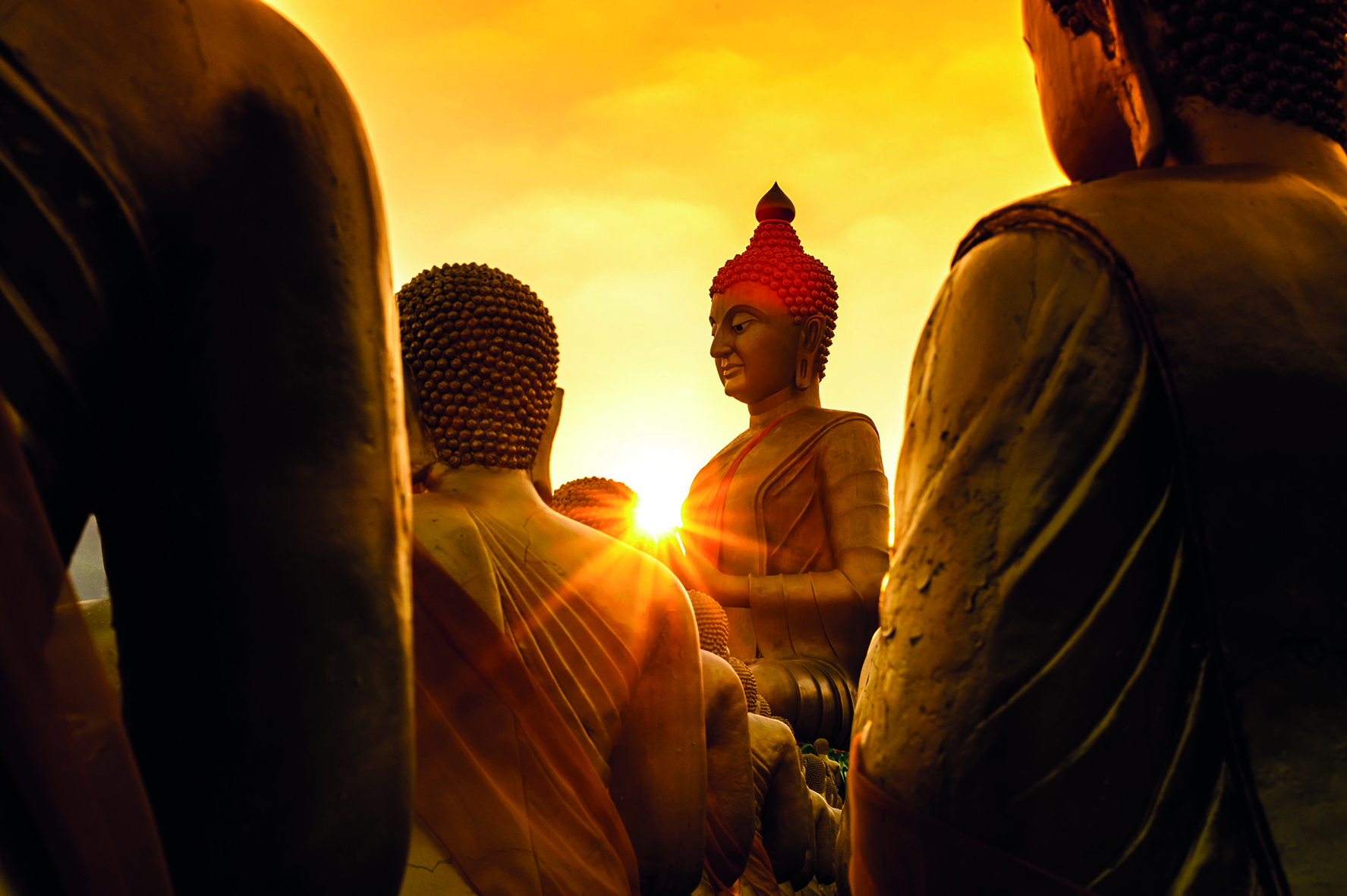
The Master of the 28th generation was a famous Indian by the name of Bodhidharma, and it was he, according to legend, who founded Zen Buddhism. He is commonly portrayed with a beard and earrings; and in Japan, a doll representing this illumined man is a very popular children’s toy. It is in fact a symbol of patience, for the dolls are so constructed that no matter how they are knocked about, they always right themselves…, most frustrating!
While Bodhidharma is said to have transferred Zen Buddhism from India to China, it was the 51st successor in the lineage, the great Japanese Master Dogen, who for all practical purposes, brought Zen across to Japan from China. Zen has widely and strongly influenced Japanese culture. Gardening, architecture, the tea ceremony, flower arrangement, archery and judo are but a few of the activities upon which Zen has left a lasting and beneficial mark.
Master Dogen
But let me return to my subject: the Rosicrucian teachings and Zen. The 13th Century Zen master Dogen, who founded the Japanese Soto Zen school, is a good guide for exploring the many similarities that exist between the Rosicrucian teachings and Zen concerning the ego. In his main literary work entitled ‘Shobo-Genzo’, which means ‘The Right-Dharma-Eye Treasury’, Dogen expresses a profound understanding of the relationship between the human being and the Universe. This insight was acquired only after many years of arduous Zen training which included the practice of Zazen, the seated form of Zen meditation. Master Dogen wrote:
To learn Buddha’s truth is to learn one’s self. To learn one’s self is to forget one’s self. To forget one’s self is to be confirmed by all dharmas. To be confirmed by all dharmas is to let one’s body and mind, and the body and mind of the external world fall away. All trace of enlightenment disappears, and this traceless enlightenment continues without end.
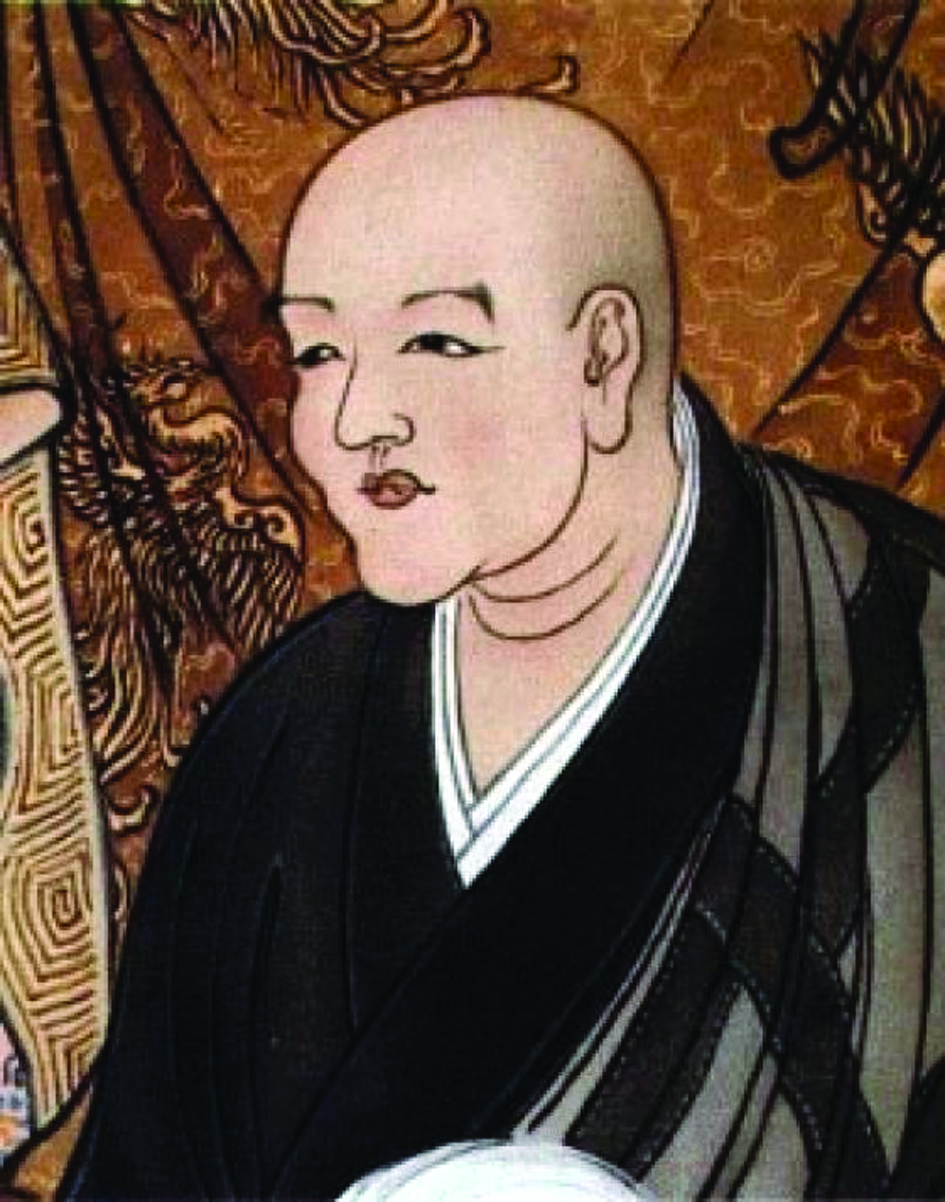
Zen Master Dogen
To Learn One’s Self
Taking the first sentence of this paragraph, ‘To learn Buddha’s truth is to learn one’s self’, one is reminded of the legendary injunction over the entrance of the temple at Delphi: ‘Know thyself.’ And that most certainly is what Rosicrucians seek too, for the main task of every true Rosicrucian is to build up a clear channel of communication between the dull mundane outer self and the radiant, sacred, inner Self. Many subjects in the Rosicrucian teachings deal specifically with this quest for self-realisation. Master Dogen taught the same, namely, that learning about one’s Self is the surest way there is of discovering the true nature of our existence and the Universe.
To Forget One’s Self
The other sentences in the quote seem enigmatic at a first glance, especially the second one: ‘To learn one’s self is to forget one’s self.’ But from personal reflection and the practice of Zen, I have learnt that this concerns the ego; for forgetting one’s self implies surely the abandonment of the ego if one wants to know the true nature of one’s being?
Several questions arise. First, what exactly is the ego? There are so many varied definitions in dictionaries that they frankly confuse rather than assist us. Strangely though, it is not that difficult to conceive of a state of being devoid of an ego. Let’s use the example of a professional skier. It’s a foggy day, the ski slope is steep and bumpy, and here and there the snow is compressed into dangerous ice plates. The positioning of slalom gates is a specialist occupation requiring the skill of an expert in order to minimise the risk of injury. A world-class skier is waiting at the start gate for the signal to go. Nervous energy courses through his tense though fully prepared body and he knows he will require all his skill and concentration to safely reach the finish line.
The signal sounds and in an instant he’s off. With the wind searing his face, he hears the sound of his skis carving the hard snow. He feels the elasticity of the skis but he can hardly see the slope ahead of him because of the thick fog. His balance is constantly disturbed, adjusted and readjusted with split-second precision as he encounters unexpected obstacles and changes in the course. But he recovers quickly because of his well-honed skills. His actions are automatic, as if something deep within the subconscious has taken full control. If even for a second he had to think about his technique, his actions would be too slow to cope and the consequences could be fatal.

Before he left the start gate, his consciousness had reached a degree of separation from his environment. There was just him and the slope, his ability and the difficult conditions ahead of him. But all thoughts were instantly blown away when he pushed away from the gate, when conditions immediately demanded his full attention. It was at that moment that the separation between himself and his environment ceased to exist and something deep within took over.
Now, speeding down the slope, he is no longer aware of his body or mind, and in his field of awareness, in his reality, he is intimately merged with the universe. We all eventually learn through experience that the only universe we can ever know is the universe of our personal reality. And the ultimate such reality is a universe completely devoid of the ego. There is oneness and harmony, and in this state, one can achieve the best one is capable of. One knows at such moments the enormity of one’s true capabilities and has reached at least a partial understanding of the meaning of Zen Master Dogen’s words: ‘To learn one’s self is to forget one’s self.’
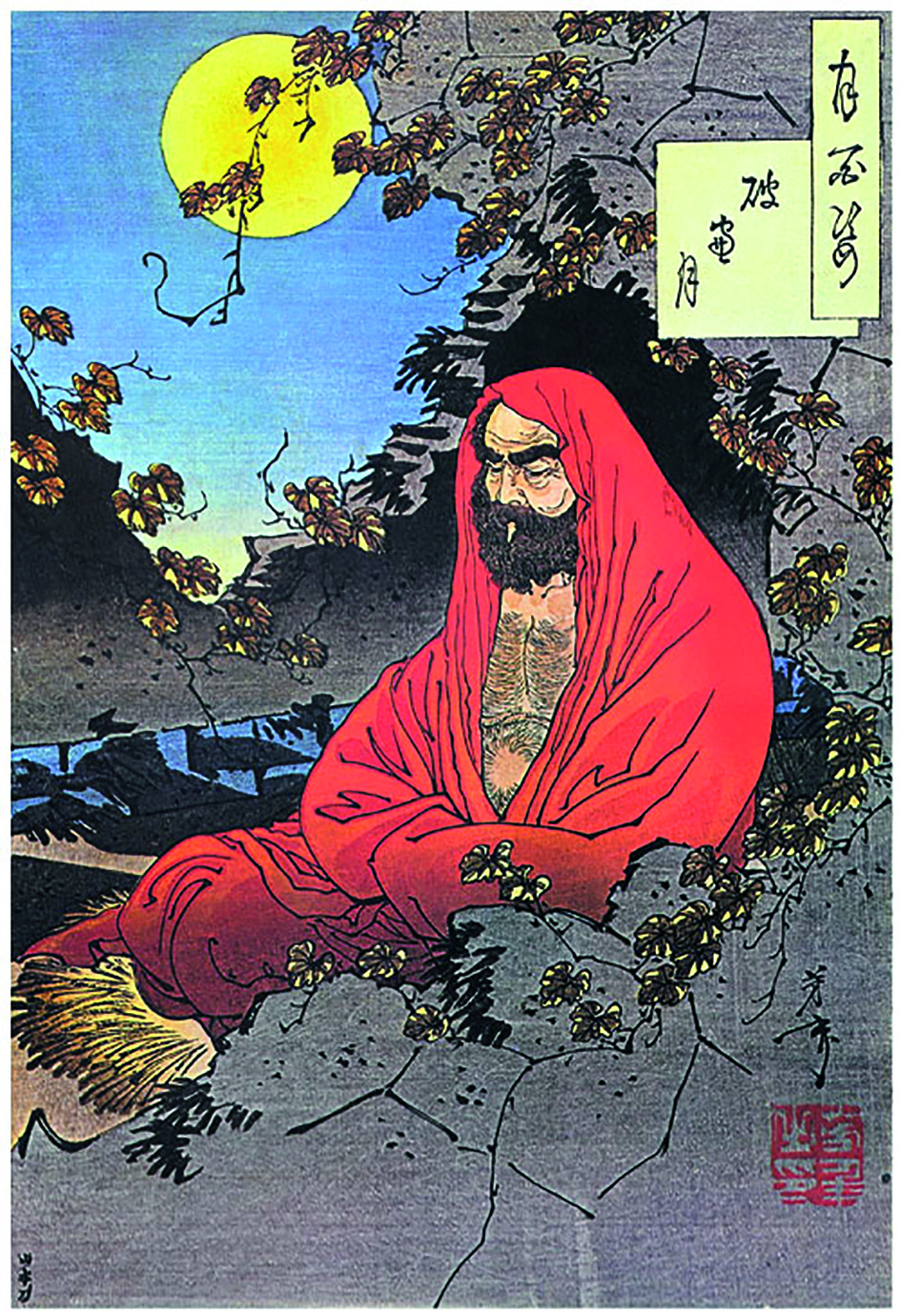
Bodhidharma, by Yoshitoshi, 1887
To be Confirmed by all Dharmas
And now to the third sentence of the quotation given earlier: ‘To forget one’s self is to be confirmed by all Dharmas.’ The Sanskrit word Dharma means ‘reality’, or things and phenomena that are real to us in the deepest sense possible. The realisation of the skier’s excellent performance depends not only on his skills but also on his full integration into the environment in which he is skiing. The world is inseparable from the skier and the skier is inseparable from the world.
If the skier were to start thinking of other competitors or to begin noticing the crowds cheering him on, or if he suddenly became aware of the dangers of the situation, or even if he started being distracted by an itch, his concentration would break in an instant, control for the movement of his body would pass from his subconscious mind to the cumbersome outer intellect, and the race would be lost.
A centipede could not walk if he had to think about how his legs needed to move. Similarly, the harmony of the skier disappears and his performance deteriorates the instant his intellect is allowed to take charge. And herein lies the ego in the broadest sense of the word, and we may conclude that it is the ego, that outermost framework of the mind, that prevents us, more than anything else, from effective action in life.
Just as fish do not notice the water they swim in, or we humans do not notice the air we breathe, so do we rarely notice the presence of the ego. The ego, without a shadow of doubt, prevents us from fulfilling our full potential, and hampers us severely in gaining an understanding of our true relationship with the Cosmic. Indeed it prevents us from understanding that at the very deepest level of our being, we and the Cosmic are inseparably one.
Mumyo
What causes the ego to exist? Buddhism says that ‘Mumyo’ is the fundamental cause of the ego and of all suffering in our lives. Mumyo means the ignorance we carry about with us through myriad incarnations, and specifically, it means ignorance of the “two basic truths.”
Syogyo-Muzyo
The first of these truths is ‘Syogyo-Muzyo.’ Syogyo means ‘all that is perceived’, while Muzyo means ‘change or the changeable.’ Together, these words mean: ‘everything perceived is changeable’, or to put it differently, ‘nothing we perceive remains unchanged forever.’ How very Rosicrucian!
The ancient Greek philosopher, Heraclitus wrote: ‘All matter is becoming’, and we know that the law of matter is above all else a law of change. Consciousness changes constantly; it is in a permanent state of flux. As one of the monograph lessons from the Rosicrucian curriculum says: ‘Since both consciousness and reality change, nothing is as permanent as it may seem.’
We have many strong attachments to things in life, and our concepts seem unchangeable…, at least for some periods of time. These temporarily unchangeable things can be our homes, our status, our physical beauty or strength, our neighbours, lovers, opinions, beliefs, reasoning abilities, etc. Our strong attachment to these things firmly supports the existence of the ego. If, like brief though intense flashes of lightning, we were to realise the true nature of the ever-changing Universe…, and if we were to realise that it is impossible to truly possess anything..., we would free ourselves from these strong attachments and the ego would as a result be vastly diminished. One part of the written teachings of the Rosicrucian Order says just this, though in a slightly different way:
Although through man-made laws we can compensate each other and thereby obtain certain rights to have the legal privilege of acquiring something for our exclusive use, we are nevertheless always indebted to the Cosmic for such benefits.
We are obligated to the Cosmic because it is through the manifestations of universal laws that all such things are made possible. Even the inspired human intelligence of the inventor or designer of something is the result of Cosmic enlightenment.
Our Guusi Attachments
Returning to our skier, he is in the oneness, the bare-bones no-ego Universe. But needless to say, not every skier reaches that great enlightenment immediately, and this is because human attachments are so persistent and last many incarnations. Buddhism compares these attachments to ‘Guusi’, namely the fibres of the lotus root which are very hard to cut.
On the other hand, our skier for example achieves the no-ego state almost exclusively through his preparatory period of concentration, followed by a release of intellectual control of that concentration at the precise moment he leaves the start gate. Zen shows that a state devoid of the ego is a natural quality of the deeper self. If repeated no-ego experiences are allowed to accumulate within us, a point is eventually reached when the erroneous paradigm of the ego is blown away forever. Practice is all we need: practice, practice, practice.
From the foregoing example, it seems therefore that some purely mundane activities can lead us to the no-ego state relatively easily. Here are a few examples:
• Listening to sounds, say music or mantra sounds, with the detached deep concentration of the inner self.
• Doing various outdoor sports which require the sort of delicate balance achievable only through abandonment of the outer intellect to the higher inner faculties.
• Acting or portraying another personality, animal or even an inanimate thing like a cascading mountain stream, and getting deep into the role.
• And then there is the Rosicrucian technique of gazing at a candle flame or frankly anything else which attracts our consciousness, and allowing the mind to enter a state of neutrality as it watches.
Many similar activities have been arranged in various forms in the written teachings of AMORC. The mystical, as opposed to intellectual form of concentration that is used during these activities, has the power to break the illusions the ego has created for us.

Syoho-Muga
The second truth of Buddhism is ‘Syoho-Muga.’ Syoho means ‘all things’ and Mu denotes ‘negation.’ The word ga is ambiguous however. One of its meanings is the ‘everlasting independent personality of the soul.’ If we use this as the meaning of ga, we gain some sense of the meaning of the entire phrase, and here it is...
...in the universe there is no such thing as an eternal, separated soul expression, for it is always changing and dependent.
In other words, no soul, and hence no expression of that soul (what Rosicrucians refer to as the ‘soul personality’) remains as it is forever, and it is ever dependent on its ultimate source. This agrees with the Rosicrucian viewpoint, for concerning the soul and its attendant expression on earth (the ‘soul personality’), another part of the Rosicrucian teachings explains it thus...
To the Rosicrucian, the soul is always connected to and is a part of the great Universal or Cosmic Soul, and is therefore never actually individualised. It does not belong to us, but to the Cosmic; it is not separated, but united. It is not independent, but dependent.'
If we thoroughly realise the temporal nature of the individuality, the ‘I’ or ego can no longer manifest. One of the Rosicrucian pamphlets we publish speaks of eliminating the ego as...
...forgetting misleading, inflated theories about individual personality; in other words, eliminating personal individuality.
The remaining part of Master Dogen’s quote says...
To be confirmed by all dharmas is to let one’s body and mind, and the body and mind of the external world fall away. All trace of enlightenment disappears, and this traceless enlightenment continues without end.
To understand this, we must delve deeper into the deep meaning behind the expression Syoho-Muga. As previously explained, the word ga has several meanings, one of which denotes the ‘fixed characteristics of things.’ Applying this meaning of ga to Syoho-Muga, we get the following sentence: ‘Nothing in the universe has any inherently fixed characteristics.’ But what exactly is meant by this? And why is it so important?
The Honourable Monk Sariputra
We have a clue in the ‘Yuima-Sutra’ which was written by an unknown author in India in the 2nd or 1st Century BCE. This very old sutra relates a beautiful and inspiring story about the inherent characteristics of things.
A heavenly maiden lived in a house where Buddhist monks held their assembly. She listened to their discourses and was so delighted and moved that she revealed her body to them and sprinkled heavenly flowers on them. The flowers that fell on the clothes of some of them did not cling and fell on the ground, whereas the flowers that fell on others clung to their clothing. They tried to remove the flowers through their supernatural powers but they could not. Eventually she spoke to one of them...
Maiden: “Honourable monk Sariputra, why are you and your brothers trying to shake off these flowers?”
Sariputra: We retired into Buddhism and are contented with honest poverty, so it is not appropriate for us to decorate our clothes with flowers.
Maiden: Honourable monk Sariputra, you should not say this, for flowers are in accord with the law of Reality; flowers neither think nor judge. But you think and judge that they are not appropriate. For those who have retired into Buddhism and are living with ultimate truth, evaluation and judgment are not appropriate with the law of Reality.
Maiden: You are evaluating and judging ultimate reality. Evaluation and judgment is not suitable for this. You should observe the monks to whom the flowers did not cling; they neither evaluated nor judged. For example an evil spirit watches for a chance to possess one who harbours fears. Similarly, he who fears birth, death and reincarnation, allows his ego to be strongly attached to the passions, to the things that his five senses perceive. But if he renounces his fears and abandons his passions for the worldly created things, his passions for the things of perception cannot affect him.
Maiden: The flowers cling only to those who are not yet free from the patterns of thinking and action that is formed by strong attachments to worldly things. But they do not cling to the clothes of the others who are free from all these patterns.
Sariputra: Honorable heavenly maiden, is not the abandonment of passions, anger and foolishness needed for the attainment of Nirvana?
Maiden: Only for those with inflated egos is there a need to follow the teachings that say that we must abandon worldly passions, angers and foolishness in order to attain Nirvana. For those without ego, the true nature of worldly passions, angers and foolishness is in itself Nirvana.
Nirvana
But can passion, anger and foolishness really amount to Nirvana? This brave assertion relates the fact that Sariputra has many frameworks falling in two categories. One is sacred and the other is worldly. For him, flowers are worldly and do not belong to the sacred world. The passions, anger and foolishness referred to are not part of the sacred either and therefore belong to the secular world. They are different from Nirvana which can only exist in the sacred realm.
But according to the heavenly maiden who made fun of him, flowers have no inherent fixed qualities like vulgar or sacred. Passion in itself does not have the quality of vulgarity, just as Nirvana does not in itself have any inherent qualities of sanctity. These natures or classifications exist only in the mind of Sariputra, so the things, desires and emotions exist independently of whatever judgment is made of him. They have no inherent qualities apart from those we ourselves create.
So, for some people, flowers are ostentatious when worn on their clothes, even though those same flowers can be offered to the Buddha as symbols of the beauty of the sacred world. Some poisons when used in minute quantities, as for example in homeopathy, can be used as highly effective healing agents. Similarly the passions, which so often confuse us, can be converted instead into great compassion because they have no inherently fixed natures. This highlights the other meaning of Syoho-Muga, namely that ‘nothing in the universe has any inherently fixed characteristics.’

If we insist on avoiding vulgarity and seek sanctity at all costs, we have a form of attachment to the ego. And if we leave the worldly life and seek Nirvana, this too is a form of attachment which we have to cast off in order to realise the true nature of ultimate reality. To put it another way, we tend to construct paradigms consisting of two opposite categories or qualities. Examples are the sacred and the profane, heaven and earth, good and bad, the passions and Nirvana, objects and ourselves, body and mind, actuality and reality, outside and inside, space and time. These are convenient for some phases of reasoning, but they are after all merely concepts that we ourselves have created. As frameworks, they do not belong to ultimate reality.
If we wish to reach that ultimate reality of God or Nirvana, we must cast off all frameworks and paradigms and stop being misled by the ego. In fact, we even have to cast off Nirvana itself. We have to cast off our concepts of God or ultimate reality if they are mere categories or concepts, for they hold us back from the actual experience of this ultimate reality.
For analogy, suppose you tasted sea urchin eggs for the first time. If you had read or heard about them before, and knew what creature they came from, you would probably not have enjoyed their taste as much as your ignorance of these facts would have guaranteed. That is why Zen Buddhism pays special attention to the limitations of language. If we use words to describe something, we inevitably separate ourselves from the reality of what we are attempting to describe. We regard things as objects, as if they existed outside of us.
Pointing at the Moon
Zen Masters often use the metaphor of an index finger pointing at the moon. With their characteristic simple though deep wisdom, they warn us of the subtle danger of confusing enlightenment, symbolised by the moon, with the description of enlightenment, symbolised by the finger pointing at the moon. Experiencing enlightenment is not the same as describing it. This is why most schools of mysticism affirm that ultimate reality transcends all intellectual concepts and defies objective description. And so it is with the Rosicrucian tradition as well. Relatively little is conveyed directly in words, but a great wealth of experience is bestowed upon us through simple rituals, a fragment of which I will shortly be quoting from.
We would do well to take heed of the two truths of Buddhism that have been covered so far, namely Syogyo-Muzyo: nothing in existence is unchangeable and Syoho-Muga: nothing in the universe has any inherently fixed characteristics. The Rosicrucian teachings and Zen agree on these two points and we should adjust our passions and attachments accordingly. By understanding Syogyo-Muzyo, and cultivating the experiences of Syoho-Muga through deliberate actions, and by pursuing our daily activities like the skier in our example, we are led to the wonderful realisation of the no-ego perfect Universe.
Being Confirmed by all Dharmas
Let us now analyse the final part of the paragraph of Zen Master Dogen:
To be confirmed by all Dharmas is to let one’s body and mind, and the body and mind of the external world, fall away. All trace of enlightenment disappears, and this traceless enlightenment continues without end.
These words are so profound that I simply cannot reduce or analyse their meaning any further. They say it all so precisely, and it cannot be clarified or expanded upon. Suffice it to say that every time I read these sentences I am overwhelmed by the most sublime emotion of deep attunement with the Cosmic. What I would like to do instead is to quote a brief passage concerning the Cosmic from a Rosicrucian ritual:
All things are within You..., and from You they continually spring forth. Cosmic Being, You are self-sufficient, for You are both creator and consumer.
Within You, things have no estimate, for nothing is without place, nothing diminishes, nothing is older or younger, lesser or greater than another.
Though You are ever changing, Your complexities are nameless. Neither air, fire, water, earth nor life exist by the distinctions by which mortals know them. Yet they are eternally contained in Your essence.
For the sake of humanity, for the future of our world, it is so important that we and all others on our beloved planet experience as soon as possible that no-ego, perfect and inseparable Universe that resides within us. Yes, this must be the foundation of that peace based on the Great Compassion that Buddhists call ‘Zihi’ and that Rosicrucians know as ‘Peace Profound.’
If the realisation is achieved, there will be no I; indeed, the Universe will become the I. Every person will help others in distress, with no special concern for reward or even recognition, just as the left hand cares for the wound on the right hand, for it is part of the same wounded body. We are all part of the same body, the great body of the Universe, the great Cosmic reality.
Close Friends
I have now reached the end, and as Rosicrucians will no doubt agree, the Rosicrucian teachings and Zen are close friends. They see the same Cosmic reality and agree in principle on the two fundamental truths of Buddhism: Syogyo-Muzyo (nothing in existence is unchangeable) and Syoho-Muga (nothing in the universe has any inherently fixed characteristics.) Through these two great truths, practitioners of the art of Zen seek to attain realisation of the one perfect, no-ego Universe. And that is so very Rosicrucian!
Many Rosicrucian aspirants and Zen practitioners the world over will one day achieve the experience of the no-ego inseparable reality and learn to live by it. From the Great Compassion to all living creatures, may the Rosicrucian Order and Zen fulfil their respective, though common, missions of bringing about a bright new era of elevated human consciousness.