An Egyptian Ritual
By Constance Dreyzel | Feb 07, 2022
This is an extract from The Rosicrucian #87 (Feb, 2022).
The following appeared in an issue of an old magazine devoted to archaeology 129 years ago. It is an observational account by the Rev. J Hunt Cooke, referring to the sarcophagus of the 19th Dynasty pharaoh, Seti I.
It is covered with inscriptions. These have recently been deciphered. They give a highly imaginative account of the supposed journey of the sun through the nether world, from its setting in the west to its rising in the east. This appears to be a medium for religious ideas and teachings in regard to the unseen. There are extant other copies of the same work, which was in all probability a sacred classic of that age.
Could we apprehend fully the meaning of the figurative language, it would doubtless be a storehouse of the spiritual thinking of ancient Egypt. Its significance may be gathered from the fact that the grand idea of celestial glory in those days was, or was figured by, a voyage across the sky in the glorious sun, which, like a ship, sailed through the heavens scattering light and blessings, in which the wicked were not permitted to take part. This honour was reserved for the elect.1
I found the article very thought provoking, not least because I had already witnessed a presentation of an Egyptian ritual drama called the Book of the Gates which resonated with Rev. Cooke’s words. Many of us in the audience fell under its spell, feeling a cleansing renewal from its pageantry. Yet most of us, I believe, were less able to follow it with our heads as we could with our hearts. It is almost always so when we deal with Egypt; the ‘dead’ past suddenly springs to life and sweeps us into its stately pattern, where we move trancelike in a reality that is more like a dream than anything we experience today. And we can never quite say why.
At a deep subliminal level we seem to know, even though consciously we remain puzzled, that we are partaking of something of deep relevance. Somewhere in the deepest recesses of our being something stirs to life, wakes from its slumber and whispers secrets only the heart can comprehend. If only we could recall what happened completely and clearly, and then translate it into words and mental images, everything would be plain. Our rational faculties struggle to arrange the symbols of this ancient form of mystical life into meaningful patterns, and we know, despite our failure to make intellectual head or tail of it all, that this was and still is important.
Our 21st century approach to life is so completely foreign to that held by the ancients that we can’t accept it as they did, as a unified whole, a finished work. We have lost that ancient collective approach that once prevailed in humankind…, and our efforts to marry the subconscious and conscious impressions together acceptably are seldom successful. We know the subconscious and conscious elements should blend seamlessly by themselves, as they did when the objective and subjective faculties of humans once functioned as a unit. Now there is a partition wall between them, something that separates them utterly…, but also something that can be taken down without much difficulty as soon as we are serious about doing so.
The Mystery Schools reach backward into the abyss of time to draw from the primordial shadow the truths still pertinent to daily life. In many mystery schools, including the Rosicrucian Order, this corpus of wisdom is known as the ‘Primordial Tradition’ and forms the primaeval core of all spiritual beliefs. Through ceremony and ritual, countless mystical schools of knowledge have for thousands of years kept before their initiates’ eyes imperishable symbols which sometimes add relevance to the kaleidoscopic figures in the so-called ‘dance of life.’
The memories that Egypt awakens in us are for the most part so deeply hidden as to make their explanation impossible on an intellectual level, without thorough mystical instruction. Exoterically, Egypt is familiar enough to us, for archaeology has presented an overabundance of artefacts. But without something more, something deeper, archaeology cannot explain Egypt to us any more than on a very rudimentary level.
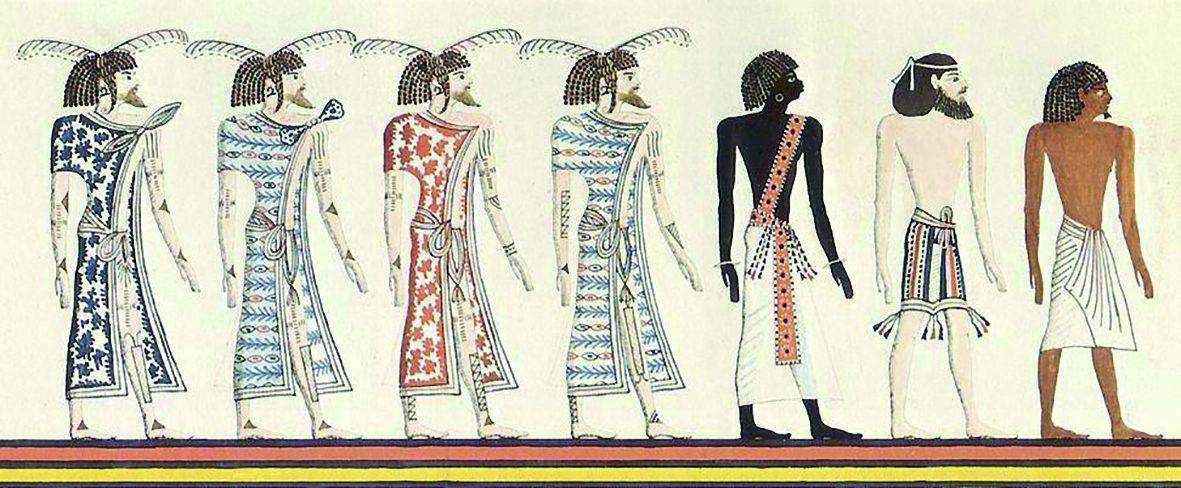
The four races of the world: Libyans (‘Tjehenu’), a Nubian (‘Nehesu’), an Asiatic (‘Aamu’), and an Egyptian (‘Rekhyt’). An artistic rendering, based on a mural from the tomb of Seti I.
Referring to the article extract above, undoubtedly there are many whose knowledge of Egyptian thought penetrates much more deeply the meaning of this story from the tomb of Seti I than does that of the author quoted. Briefly, he is not too sure of the intent of the account, which he calls “highly imaginative”, of the sun’s supposed journey to the netherworld. He naturally presumes it to have held significance for the Egyptians, to have been in fact a variant version of a classic tale, and to have served as a kind of medium for the expression of religious ideas. Indeed, he suggests that if it could be understood correctly it might furnish a key to the entire belief system of the ancient Egyptians.

Detail from one of the many versions of the ‘Egyptian Book of the Dead.’
A Book of Life
We now know that this story which he called an Egyptian classic is a variant of the Book of the Dead, hundreds of copies of which were scattered throughout Egypt at one time, and some of which have survived in Egyptian collections. The fact that this title has impressed itself upon our thought no doubt is responsible for our judging it to be altogether funereal in character. Found in mummy wrappings, on sarcophagi, and on the walls of tombs, the Book of the Dead is in fact a book of life rather than of death. Although in variant form it tells the story of the sun as the predominant god of ancient Egypt, in broad terms it also had a unique, individual meaning for every Egyptian. For Egyptians, Ra, the supreme solar deity, was the most dependable guide they could have for their respective journeys through life, for their journeys out of this life, and for their journeys back into it again.
That is to say that, out of a representation of the daily departure of the sun in the west and its process through the measured hours of darkness to its reappearance as a new sun on the eastern horizon, there grew the belief that as with the solar deity so it was with humans too. The Egyptians imagined that as the individual passes from life through the door of death, and thereafter through the dark regions of the western Amenti (the place of testing), there was a subsequent resurrection into life on the eastern horizon. A representation of a natural fact of life, namely sunset, the dark hours of the night, sunrise and the light hours of day…, was therefore given a spiritual or eschatological relevance.
Familiarity with the sun’s experience in the netherworld and the means by which it triumphed over the powers of darkness gave humanity the supreme assurance it needed to succeed in its own journey through birth, life, death and the afterlife. Gerald Massey in his old treatise Ancient Egypt: The Light of the World (1907) has painstakingly pointed this out:
The so-called Book of the Dead is the Egyptian book of life: life now, life hereafter, life everlasting. It was indeed the book of life and salvation, because it contained the things to be done in this life and hereafter to ensure eternal continuity. The departing soul, when passing away in death…, or as the truer phrase is, when setting forth into the land of life, clasps and clings to his scroll for very life. As the book of life, or word of salvation, it was buried in the coffin with the dead when done with on earth. It showed the way to heaven objectively as well as subjectively, as heaven was mapped out in the astral myths. 2
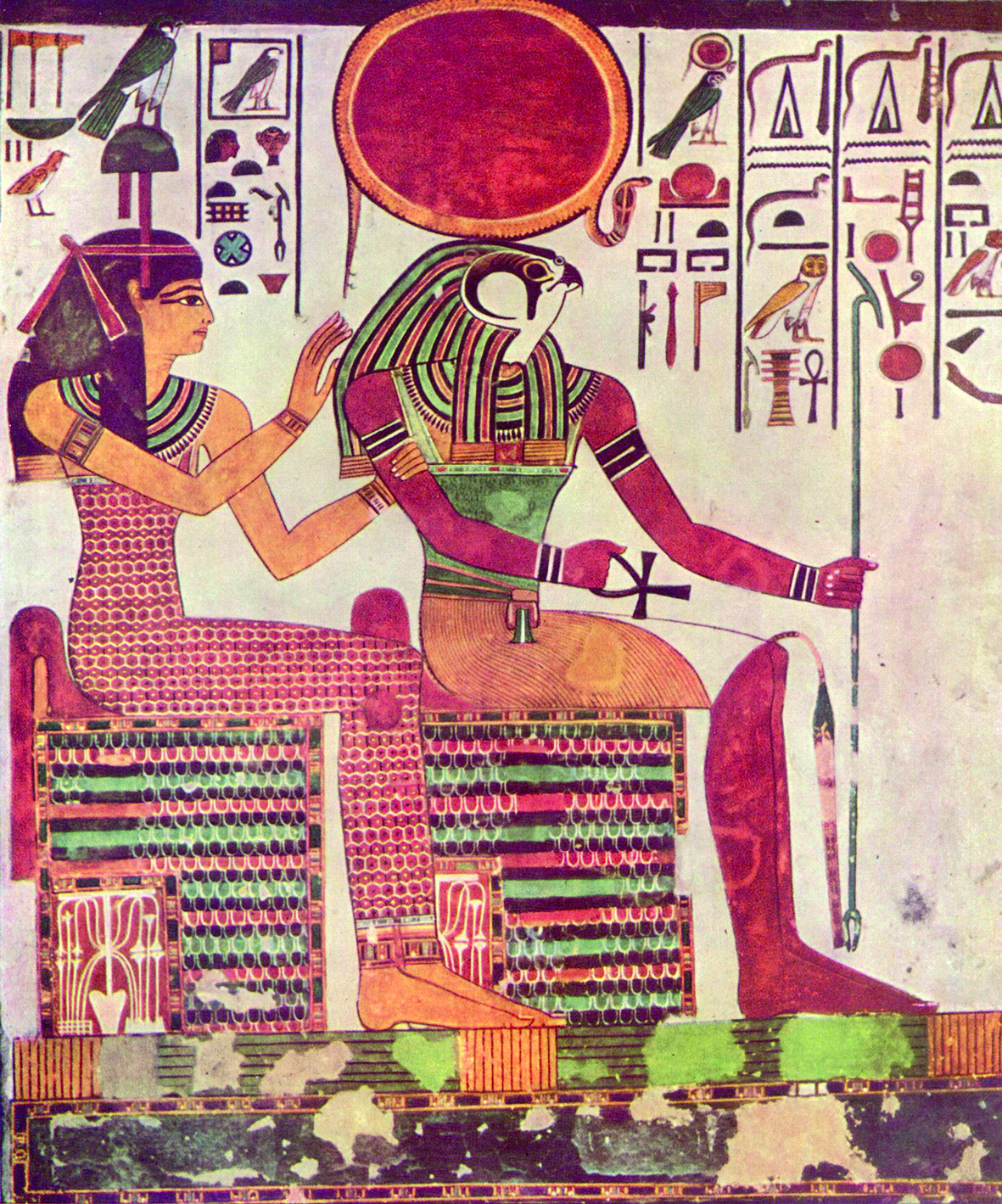
Imentet and Ra from the tomb of Nefertari, 13th Century BCE.
The departing soul then, was depicted with a scroll similar to the one placed within the folds of the mummy windings. This scroll had clear directions for the deceased: how to move forward into the underworld with confidence, what words of truth were needed to break the spells of various hindering powers, and what power the individual had at his or her disposal from a life lived according to Maat (truth). When the deceased arrived at the judgment hall in Amenti, the scrolls, the material one from the mummy windings and the immaterial one written into the character of the real self, would be brought together for comparison, so the judge might decide how far the word of Maat had been fulfilled in the life of the deceased, and whether the gift of life had been sufficiently earned.
As in the material world so in the nether regions, the Egyptians argued, no one can travel without knowing the way. According to Gerald Massey:
The way in Amenta [sic] was indicated [...] topographically very much in keeping with the ways in Egypt, chief of which was the waterway of the great river [Nile]. Directions, names and passwords were furnished in writing, to be placed with the mummy of the deceased. Better still, if these instructions and divine teachings were learned by heart, had been enacted and made into a living truth in life, then the Book of the Dead in life became the book of life in death. The word was given that it might be made truth by doing it as the means of learning the way by knowing the word. The way of life in three worlds, those of earth, Amenta and heaven, was by knowing the word of God and making it true in defiance of all the powers of evil. 3
The Living Memorial
The beauty of the ritual is now manifest…, a living classic, not a dead memorial. It serves humanity in the light of life as well as in the darkness of death. It gives humanity knowledge of universal laws always in operation and assurance that knowledge gained from it is our safeguard at all times, a key to accomplishment, a pass to power.
The sun is after all but a prototype of the saviour of each individual person. It is used to illustrate the operation of beneficent, universal laws. The sun’s daily progress through the heavens is to be read as symbolic of our daily progress through the circle of life. It expresses the continuity of life and the inevitability of final triumph.
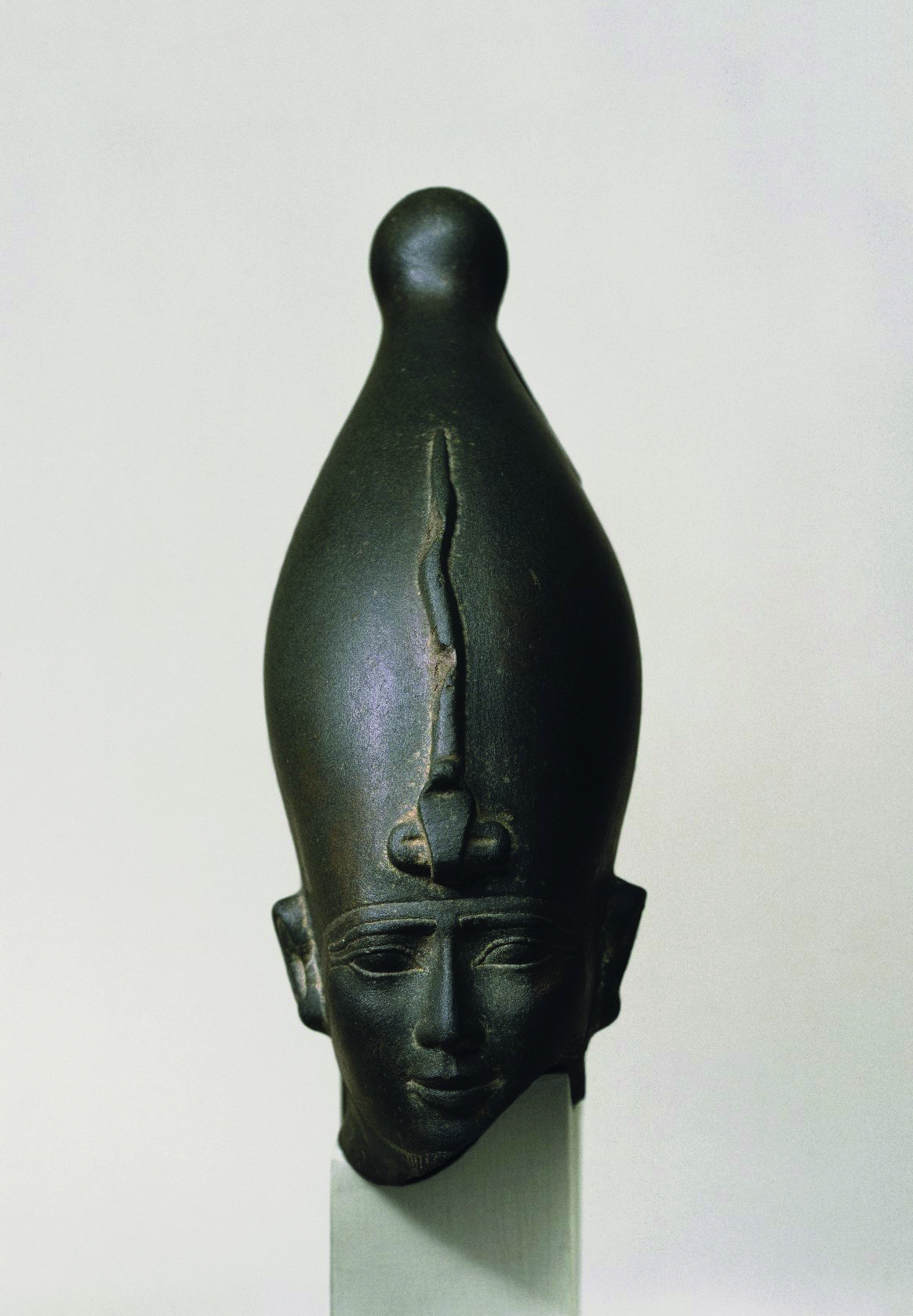
Head of the God Osiris, ca. 595-525 BCE.
In the Ritual, the sun, entering the cleft in the Western Hills, is the mummified Osiris. It is symbolised by the scarab beetle enclosed in a disk of light. The solar deity’s companions in the “Sektet” boat (the evening solar barque)4 are Sa and Heka. Sa represents foreknowledge or intelligence, while Heka represents the power of the Word. Who could ever be fearful with such powerful companions? The conflicts in life and in Amenti are a reflection of the eternal conflict of daylight and darkness, a divine warfare in which the god Horus represents light and his uncle Set represents darkness.
Shorn of all elaboration then, the ritual called the Book of the Dead, Book of Hades or Book of the Gates is a cosmic drama. Universal forces and operations are given personalities and names and made the actors. We witness it as a moving show in which we are both spectator and participant. Eternal lessons are set out for our instruction and use; eternal truths unfold as we act them out. We know the beginning and the end, for knowledge of one begets knowledge of the other. Death and Life..., Darkness and Light..., what are they but changing aspects of the same thing, pictures in a cosmic kaleidoscope? To die is to live, and for those dying within the law, the ‘second death’ has no power.
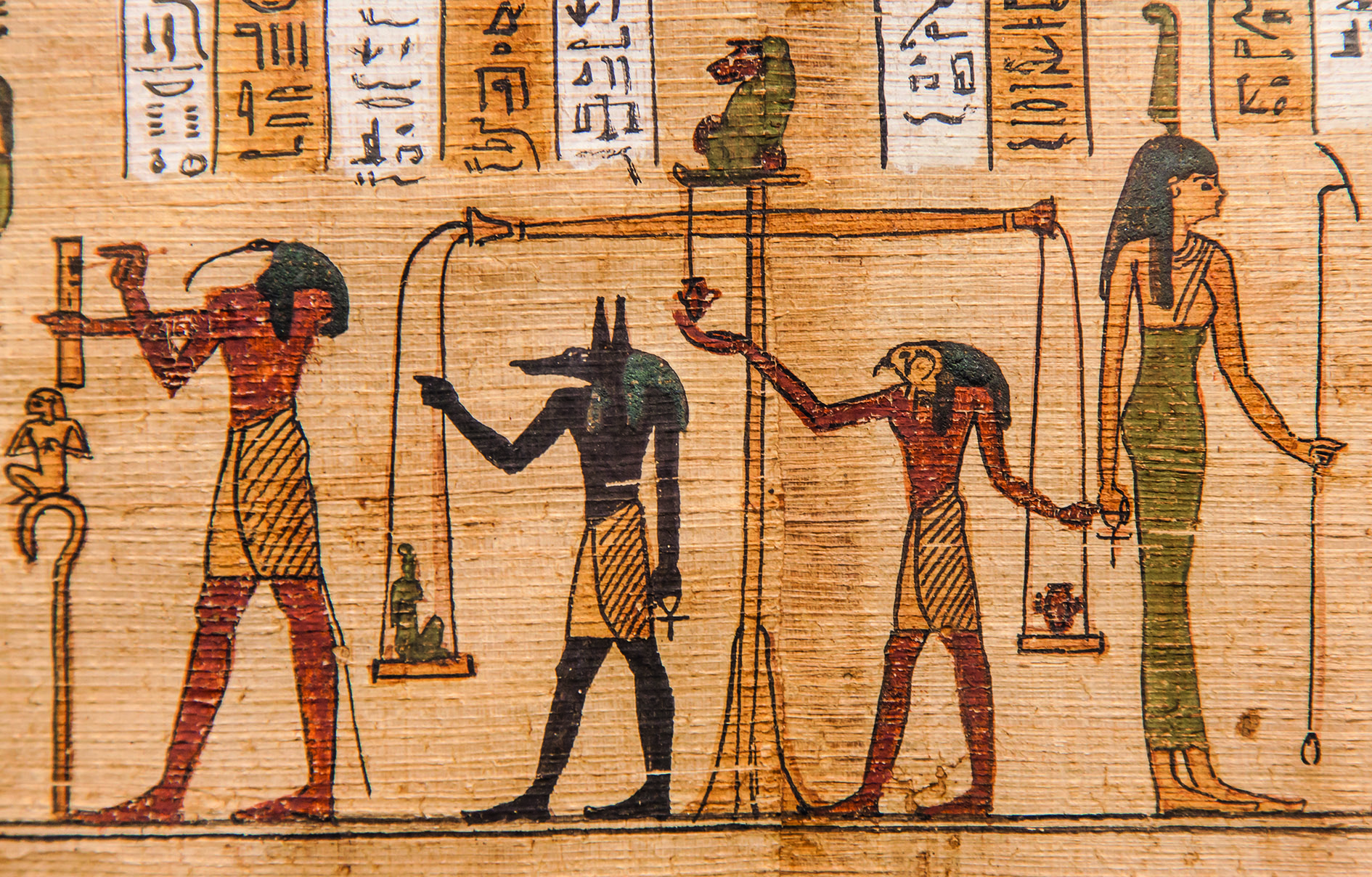
Detail from one of the many versions of the ‘Egyptian Book of the Dead’ (1070 BCE).
Final Triumph
In a word, the theme is a universally familiar one, that of the final triumph of light over darkness and, finally, resurrection and reincarnation. Its elements, the book of life whose perfect precepts must be transformed into living character, are those which have gone into parables since time immemorial. Its pattern and phraseology are such as have been repeated by teachers, seers and sages from Egyptian times to our own.
We cannot fail to respond, for these lessons have been before us for at least five thousand years and are a part of the unconscious heritage of humanity. They may appeal first to our emotional, subjective side, but later they capture our rational, objective selves too. In time, every sincere mystic penetrates the meaning of the symbols which surround them, and they encounter the unity of all as it rests serenely in its centre. When that attunement with the universe is perfect, union with the Divine will have been accomplished.
Endnotes
- Cooke, Rev. J. Hunt, ‘The Book of Hades’ in Biblia, Vol.VI, No.8, 1893
- Massey, Vol.1, p.195
- Ibid., p.196
- The Matet boat was the morning barque used by Ra to travel across the sky from the eastern horizon by day in comparison to the Sektet boat for his descent to the west or Amenti. “May he set out with thee in the Matet Boat, may he come into port in the Sektet Boat, and may he cleave his path among the stars of heaven which never rest.” Extract from ‘A Hymn of Praise to Ra’ in the Book of the Dead.