

Albert Schweitzer Reverence for Life
By Bill Anderson | Aug 02, 2021
This is article is an extract from The Rosicrucian #85 (Aug 2021).
The modern west-central African country of Gabon is little known outside the Francophone world. It is bordered by Equatorial Guinea to the northwest, Cameroon to the north, the Republic of the Congo (Brazzaville) on the east and south, and the Gulf of Guinea and the Atlantic Ocean to the west. With its capital in Libreville, the country has nine provinces, and it is to one of the nine that we will turn our attention.
The longest river in Gabon is called the Ogooué, which gives its name to five of the country’s provinces. The capital of the province of Moyen-Ogooué is called Lambaréné with a current population of over 25,000. What is so special about Lambaréné is that about 100 years ago a remarkable man built a hospital here and made it his home and life’s work. His name: Dr Albert Schweitzer.
Oganga, the Giver and Taker of Life
In the late 1990s there was a TV series called “The Adventures of Young Indiana Jones.” In the episode called “Oganga, the Giver and Taker of Life”, set in January 1917, Indy and company on their way from East Africa to Port Gentil on the Gulf of Guinea succumb to disease, and are picked up by Albert Schweitzer and the orderlies from his jungle hospital. At first, resistant to being treated by a German, Indy soon begins to realise that Schweitzer is not interested in war, and his only wish is to cure people against all odds.
At one point we find Indy and Schweitzer journeying by boat up-river to attend to a sick patient in one of the local tribes. They have a conversation about the breakdown of civilisation of which the First World War was just a symptom and not the cause. Schweitzer asks Indy if he would ever consider going into a stranger’s home and slaughtering everyone he found there. Of course, Indy says no. To which Schweitzer replies:
When governments do this in a war, millions of people, just as moral and ethical as us, flock to the colours to do their ruler’s bidding without a second thought. Why?
Indy says it’s not the same thing to which Schweitzer replies that that is what Indy was taught to believe and that society only wants people to follow and not to think for themselves. It wants servants who do as they are told. People prefer society to do their thinking for them because it’s easier. It takes away the need to make moral judgements. He continues:
Just imagine this world if no-one could rely on a country to justify its actions. And imagine if every person had to give a personal account for all they did. The hope for humanity lies not in nations, governments, religions or even the stars. It lies only in the human heart.
Imperial Background
The last decades of the 19th Century saw various European powers attempting to carve out empires on the African continent, the so-called ‘Scramble for Africa.’ We term this Imperialism and Britain, France, Belgium and Germany vied with each other to extend their spheres of influence and exploit the riches they found there at the expense of the local people.

Relief Map of Gabon.
As Europe was engulfed in the First World War, the allies also attacked the German colonies in Africa: German East Africa (Now Tanzania, Rwanda and Burundi), German South West Africa (now Namibia), Kamerun and Neukamerun (now Cameroon, with parts of Chad, Central African Republic, the Republic of the Congo, Nigeria and Gabon), Togoland (now Togo and part of Ghana). In this little-heard-of theatre of war many people died on behalf of their imperial masters.
Early Years
Ludwig Philipp Albert Schweitzer was born on 14 January 1875 in Kaysersberg, in Upper Alsace (at the time a part of Germany, but now in France) into a world long since lost. Compared to the rest of France, Alsace enjoyed a climate of religious tolerance. Alsace had been part of the Holy Roman Empire until 1639, when most of Alsace was conquered by France under Louis XIII. It returned to German rule after the Franco-Prussian war of 1870-71. At the end of this war, the German states proclaimed their union as the German Empire under the Prussian king finally uniting Germany as a nation-state.
The son of Louis Schweitzer and Adèle Schillinger, six months after he was born, his father moved the family to his wife’s village of Günsbach and there became the pastor of the small Protestant community. The medieval parish church was shared by the Protestant and Catholic congregations, who held their prayers in different areas at different times on Sundays. This compromise arose after the Protestant Reformation and the Thirty Years’ War (1618-1648). Albert spent his childhood in the approximately 100-house Alsatian village with his three sisters and one brother, where his father taught him how to play music. This tiny village is home to the Association Internationale Albert Schweitzer (AIAS) or the International Albert Schweitzer Association. Albert grew up in this exceptional environment of religious tolerance and developed the belief that true Christianity should always work towards a unity of faith and purpose.
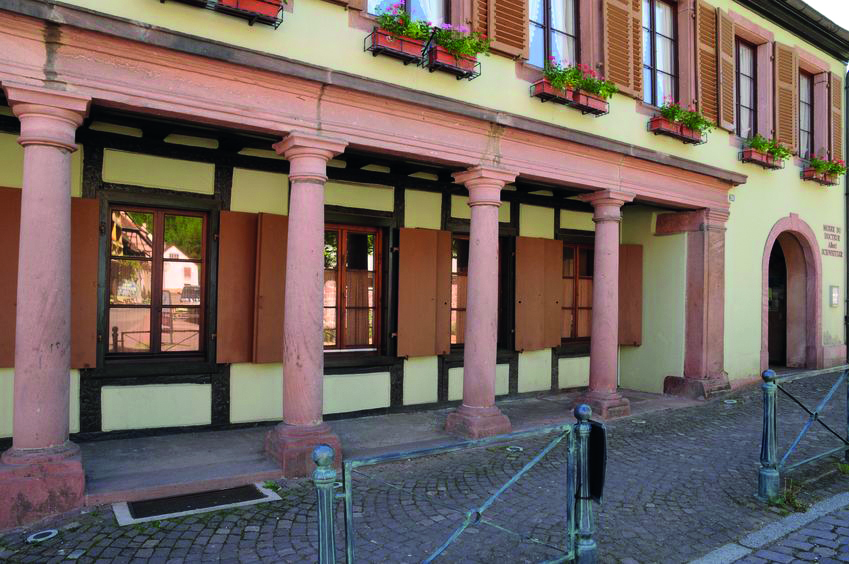
Albert Schweitzer's house in Kaysersberg.
There is a 1956 film (nowadays available on DVD) about Albert Schweitzer shot in the homely 1950s-style of American films which is narrated by Schweitzer himself. It won an Oscar in 1957. His accent was so like Swiss that it was a bit strange to the ear, if you are used to modern German. He talks about his life in Günsbach where he had a happy childhood. Being rather frail at the time, the fresh air and exercise turned him into a strong boy. He was in Primary School from 1880 to 1884 and describes himself as a quiet and dreamy pupil who had to make an effort to learn to read and write. He felt he didn’t fit in at school and that the other children thought he was better than them because his father was a pastor. They made him feel like an outsider.
Before bed, he said, he prayed for all beings, human and animal, and ask for them to be kept from evil and left to sleep in peace
When nine years old his life changed, and from 1884 to 1885 he attended the Secondary School in Münster, further up the valley. He used to walk through the countryside alone, deep in his own thoughts and became acutely aware of the different seasons and their effect on Nature. He also became increasingly troubled by the amount of hardship and misery he saw around him: “I never really knew the light-hearted youthful enjoyment of life.”
He was particularly saddened by the plight of animals who suffered so much pain because of human carelessness and cruelty. Before bed, he said, he prayed for all beings, human and animal, and ask for them to be kept from evil and left to sleep in peace. He recalled an incident one sunny summer’s day when he and a friend went out with slings to hunt birds. Just as they were about to let fly, the church bells rang out and into Albert’s mind came the words “Thou shalt not kill!” It made a deep impression on him, one he remembered for the rest of his life.
At the school in Mülhausen where he was between 1885 and 1893, he received his ‘Abitur’, the certificate at the end of secondary education. He studied the organ during this time with Eugène Munch, organist at the Protestant cathedral, who inspired Schweitzer with his great enthusiasm for the music of the German composer Richard Wagner. In 1893 Schweitzer played for the French organist Charles-Marie Widor (1844-1937) in Paris, for whom J. S. Bach’s organ music contained a mystic sense of the eternal. Deeply impressed, Widor agreed to teach Schweitzer without fee, and a great influential friendship began.
"... I had found my way to the principle in which affirmation of the world and ethics are joined together!"
From 1893 Schweitzer studied theology and philosophy at the Kaiser Wilhelm University in Straßburg (later Strasbourg). There he also received instruction in piano and counterpoint from professor Gustav Jacobsthal and associated closely with Ernest Munch (the brother of his former teacher), organist of St William church, who was also a passionate admirer of J.S. Bach’s music. Schweitzer served his one-year compulsory military service in 1894. He saw many operas of Richard Wagner in Strasbourg and in 1896, managed to visit the Bayreuth to see Wagner’s “Der Ring des Nibelungen” and “Parsifal”, both of which deeply impressed him.
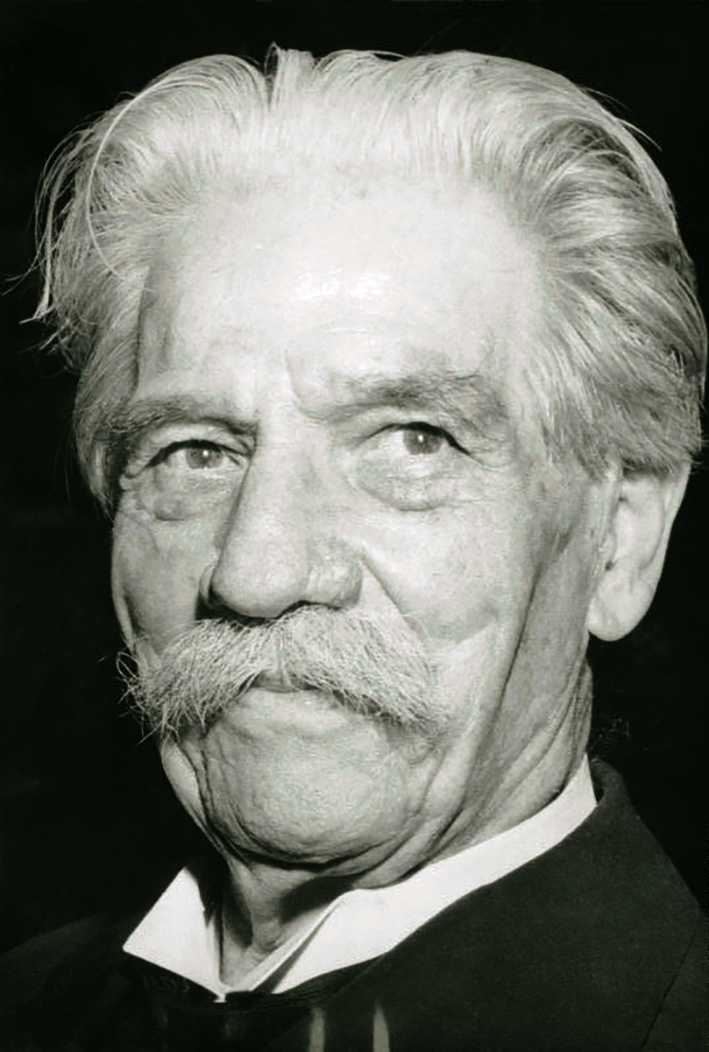
Albert Schweitzer
In 1898 he returned to Paris to write a PhD. dissertation at the Sorbonne on the religious philosophy of Kant, and to study in earnest with Widor. In 1899, he spent the spring and summer semesters at the University of Berlin where he met some outstanding representatives of the scientific and spiritual life of the time. At the turn-of-century celebrations in Berlin, he did not share in the general euphoria and optimism of the new century, but saw instead storm clouds on the horizon. He eventually received his PhD in theology from the University of Strasbourg and published his thesis at the University of Tübingen in 1899. Having decided to go to Africa as a medical missionary rather than as a pastor, Schweitzer began in 1905 to study medicine at the University of Strasbourg and received his MD from them in 1913.
Having finally received his medical degree, he sailed for Africa where he lived until 1917. On 16 April, 1913, he arrived at Lambaréné in French Equitorial Africa (later the Gabon). However, when World War I broke out a year later, he was placed under house arrest as a German citizen in a French colony. With much time to spare, in 1915 he started work on his “Philosophy of Civilisation”, where his thoughts on “Reverence for Life” first appear. This phrase is a translation of the German phrase: “Ehrfurcht vor dem Leben”, words which came to Schweitzer during a boat trip on the Ogooué River while pondering a way forward for humankind and searching for a universal concept of ethics for his time. He explains:
In that mental state, I had to take a long journey up river. Lost in thought, I sat on the deck of the barge, struggling to find the elementary and universal concept of the ethical that I had not discovered in any philosophy. I covered sheet after sheet with disconnected sentences merely to concentrate on the problem. Two days passed, and then late on the third day, at the very moment when, at sunset, we were making our way through a herd of hippopotamuses, there flashed upon my mind, unforeseen and unsought, the phrase: “Reverence for Life.” The iron door had yielded. The path in the thicket had become visible. Now I had found my way to the principle in which affirmation of the world and ethics are joined together!
Schweitzer made this phrase the basic tenet of an ethical philosophy, which he developed and put into practice. He gave expression to its development in numerous books and publications during his life and also in manuscripts, some of which have only recently been published. The main work was his unfinished four-part “Philosophy of Civilisation” subtitled “The World-view of Reverence for Life.” He also used his hospital in Lambaréné to demonstrate this philosophy in practice.
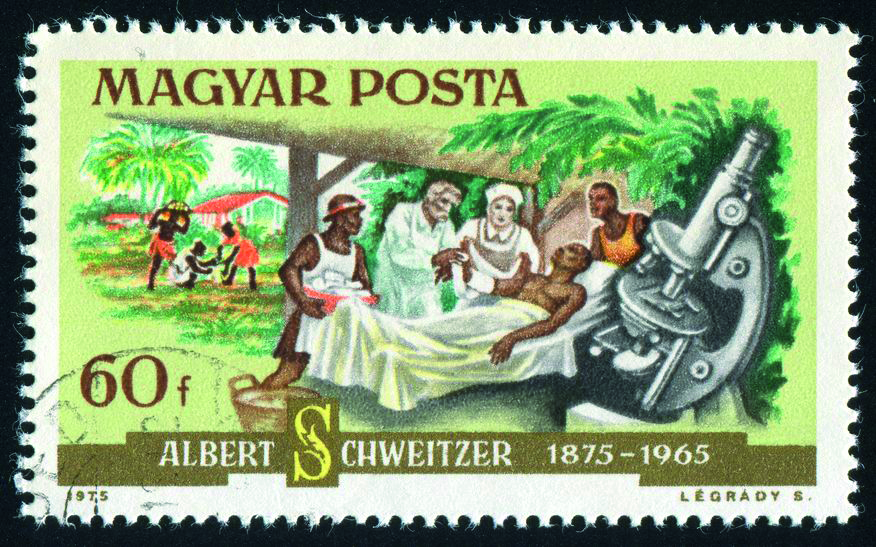
In 1917 Albert and his wife Helene were sent to a French internment camp as prisoners of war, first to Bordeaux, then to the Pyrenees and finally to Saint-Rémy de Provence. Released in 1918, Schweitzer spent the next six years in Europe, preaching in his old church, giving lectures and concerts, taking medical courses and writing “On the Edge of the Primeval Forest”, “The Decay and Restoration of Civilisation”, “Civilisation and Ethics”, and “Christianity and the Religions of the World.”
He finally returned to Lambaréné in 1924 and except for relatively short periods of time, spent the rest of his life there. With the funds earned from royalties on his books, and personal appearance fees at lectures, and with funds donated from all parts of the world, he expanded the hospital to 70 buildings which by the early 1960’s cared for over 500 patients in residence at any one time. The patients and their carers would come by canoe as the hospital was close to the river.
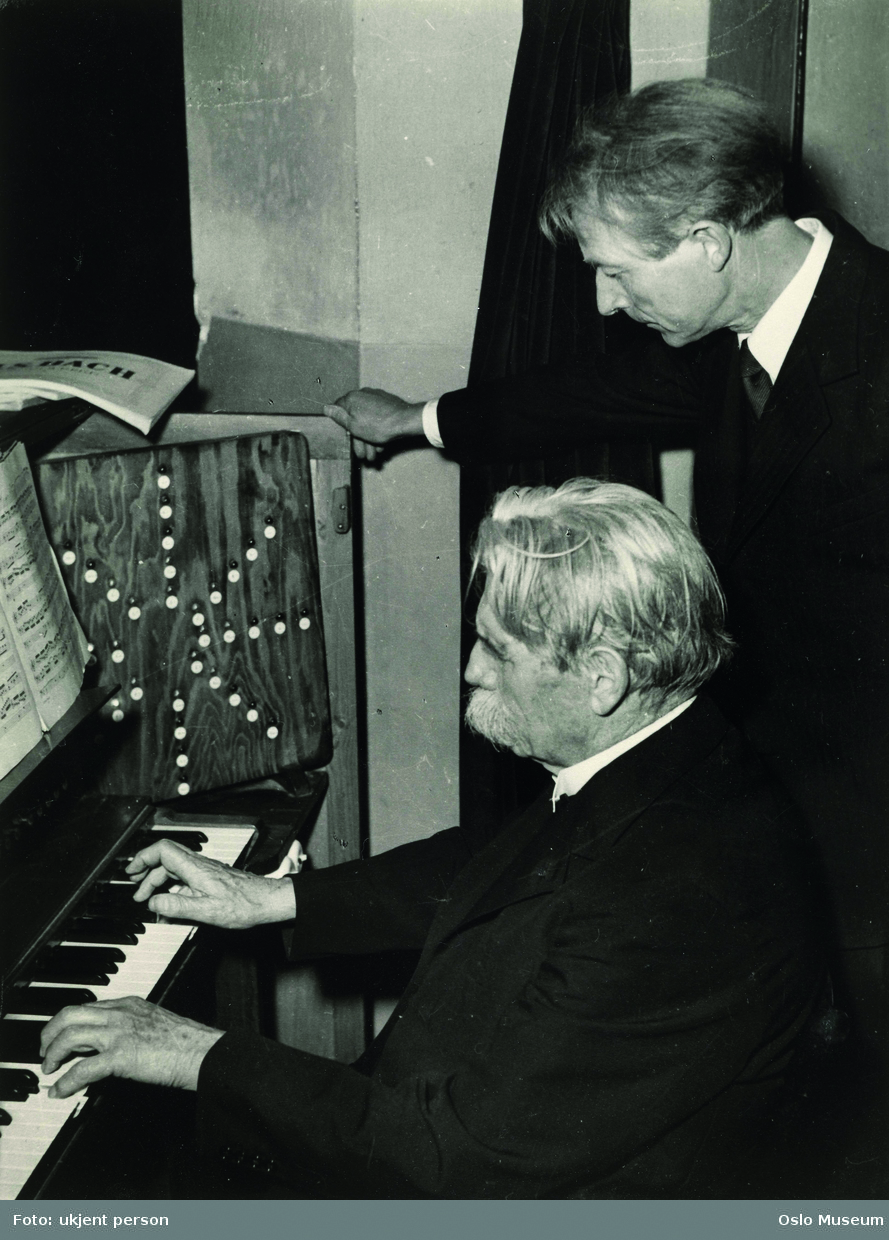
At Lambaréné, Schweitzer was doctor and surgeon in the hospital and host to many visitors. The honours he received were numerous, including the Goethe Prize of Frankfurt and honorary doctorates from many universities emphasising one or other of his achievements. The Nobel Peace Prize for 1952 was awarded to him on 10 December 1953. He passed away peacefully on 4 September 1965 and was buried at Lambaréné.
Reverence for Life
Schweitzer believed that reverence for life is a concept that develops from close observation of the world around us. In his “Civilisation and Ethics” he expressed this in the following words:
Ethics is nothing other than Reverence for Life. Reverence for Life affords me my fundamental principle of morality, namely, that good consists in maintaining, assisting and enhancing life, while evil destroys, harms or hinders life.
James Brabazon, who wrote a biography of Schweitzer defined Reverence for Life as follows:
Reverence for Life says that the only thing we are really sure of is that we live and want to go on living. This is something that we share with everything else that lives, from elephants to blades of grass, and of course, every human being. So, we are brothers and sisters to all living things, and owe to all of them the same care and respect that we wish for ourselves.
Schweitzer hoped that the ethic of Reverence for Life would make its way in the world on the basis of his explanation of it in his books and talks, the example of his life and the force of its own argument based on its depth of fundamental thought.
He believed that ethical values, which could underpin the ideal of true civilisation, had to have their foundation in deep thought and be world- and life-affirming. He therefore embarked on a search for ethical values in the various major religions and world-views accessible to him, but found none that were able unequivocally to combine ethics with life-affirmation. It was not until two years after moving out to Gabon to establish the Albert Schweitzer Hospital that he finally found the simple statement which answered his quest.

The old Albert Schweitzer Hospital, Lambaréné, Gabon.
In his autobiography “Out of My Life and Thought”, Schweitzer explains that at the beginning of the summer of 1915 he awoke from a sort of mental daze, asking himself why he was only criticising civilisation and not working on something constructive. He relates how he then asked himself what civilisation really is, and answered as follows:
The essential element in civilisation is the ethical perfecting of the individual as well as society. At the same time, every spiritual and material step forward has significance for civilisation. The will to [advance to] civilisation is the universal will to progress, [one] that is conscious of the ethical as the highest value. In spite of the great importance we attach to the achievements of science and human prowess, it is obvious that only a humanity that is striving for ethical ends can benefit in full measure from material progress, and can overcome the dangers that accompany it.
Philosophy of Civilisation
The “Philosophy of Civilisation” is a philosophical work of impressive scope and depth. Originally published in 1923, it contains Schweitzer’s most thorough and scholarly discussion of his ideas on ethics and the reverence for life. The term ‘civilisation’ referred to in the title refers not to mere political, artistic or religious structures, but to the entire Weltanschauung, or world-view, of society and individuals. Schweitzer first defends the idea that philosophy matters, and in fact defines the way people live and value their lives.
He explains why he feels modern philosophy, and therefore civilisation, is failing. He blames the lack of idealism and optimism in philosophy on the abandonment of Rationalism. If all that philosophy does is tell the world what people don’t know, then what, he argues, are people to dream of, and why should they try and improve things for themselves? With thoroughness and amazing breadth typical of his scholarly works, he then reviews the major features of Western philosophy from Greece through to Rationalism, Kant, Hegel and Nietzsche.
The last six chapters present Schweitzer’s own philosophy. Based on the will to live of all creatures, it is a corpus of ethics which accept that, in the experience of each living creature, its life is fundamentally important to it, and we should therefore not treat other living species callously or thoughtlessly. Each species of life should be revered, indeed there should be gratitude by humans for its existence. But this is not a life- or world-denying philosophy, leading to asceticism and withdrawal. Rather, it is a call to be conscious and considerate of the right to life of all creatures, but especially to find some way to help others of our own human species.
Schweitzer knew from a very young age that his calling was to serve others in whatever way he could.
Some are called to a lifetime of service to humanity, others are not. Schweitzer knew from a very young age that his calling was to serve others in whatever way he could. Regardless of our circumstances, he argues, we are all called to some level of service to others and not merely to serve our own interests. All people are called to at least make conscious decisions about every one of their actions, thereby taking conscious responsibility for what they do.
All actions, he argues, are ethically dangerous, but he does not prescribe what people must do, for that is not his true interest. The key thing is that people must consciously make their own decisions in the full knowledge that every decision has consequences, both good and bad. All people then, armed with the knowledge that their decisions affect the lives of others, must and do the best they can not to harm other lives, but ideally preserve and even improve them. Schweitzer quoted the following from the Roman philosopher Lucius Annaeus Seneca (4 BCE – 65 CE):-
No man is nobler than his fellows, even if it happens that his spiritual nature is better constituted and he is more capable of higher learning. The world is the one mother of us all, and the ultimate origin of each one of us can be traced back to her, whether the steps in the ladder of descent be noble or humble. To no one is virtue forbidden; she is accessible to all, she admits everyone, she invites everyone in: free men and freedmen, slaves, kings and exiles. She regards neither birth nor fortune; the man alone is all she wants. This, in fact, is the demand which is laid upon each man, namely that he works, when possible, for the welfare of many. If that is impracticable, then he works for the welfare of a few. Failing that, for the welfare of his neighbours, and if that is impossible, for his own.
Jain Thought
According to some authors, Schweitzer’s thought, and specifically his development of the reverence for life theme, was influenced by Indian religious thought and in particular by the Jain principle of Ahimsa (non-violence). Indeed there was undoubtedly some influence and this is noted in his book “Indian Thought and Its Development.”
The laying down of the injunction not to kill and not to damage, is one of the greatest events in the spiritual history of humankind. Starting from its principle, founded on world and life denial, of abstention from action, ancient Indian thought -- and this is a period when in other respects ethics have not progressed very far -- reaches the tremendous discovery that ethics know no bounds. So far as we know, this is for the first time clearly expressed by Jainism.
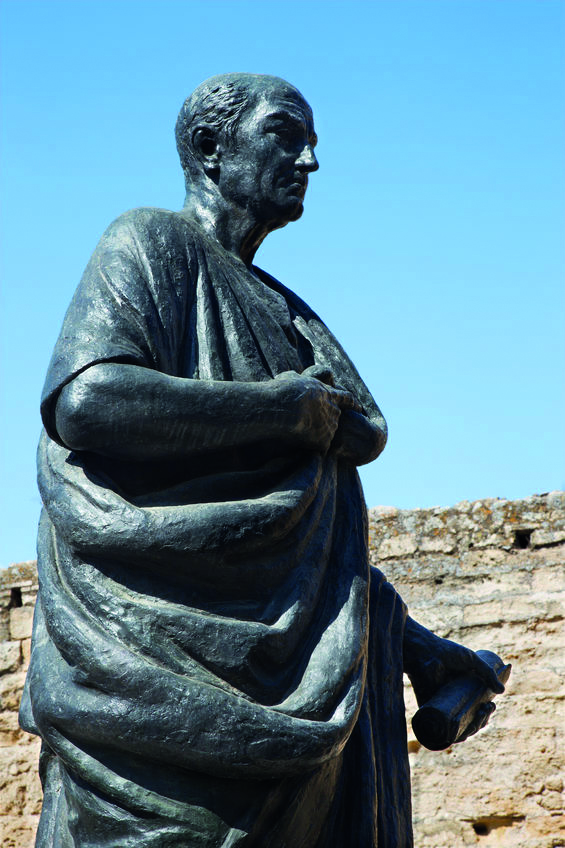
The Roman philosopher Lucius Annaeus Seneca.
Epilogue
When in his early teens, Schweitzer twice went fishing with friends“because they asked me to.” But…
This sport was soon made impossible for me by the treatment of the worms that were put on the hook, and the wrenching of the mouths of the fish that were caught, and I gave it up. From experiences like these, which moved my heart, there slowly grew up in me an unshakeable conviction that we have no right to inflict suffering and death on another living creature, and we ought, all of us, to feel what a horrible thing it is to cause suffering and death.
The concept of reverence for life was incipient in Schweitzer almost from birth, and this awareness affected him throughout his life, as when he would gently scoop a spider out of a hole it had fallen into before planting a seed there to feed his patients and their families who also worked on the hospital farm. He wrote that just as our existence is important to each of us, “[a creature’s] existence is significant to it. My relation to my own being and to the objective world is determined by reverence for life, a reverence given as an element of my will-to-live…” And this will-to-live, he often stated, exists in all creatures and humans. As the highest and most intelligent of them all, humans should have no difficulty respecting the wishes of those less capable than them.
Dr Albert Schweitzer died on 4 September 1965 at his beloved hospital in Lambaréné. His grave, on the banks of the Ogooué River, was marked by a cross he made himself. The Albert Schweitzer hospital has been the primary source of healthcare for the surrounding region since it was founded in 1913 and remains so to the present. Its research laboratory is one of five leading facilities in Africa engaged in the scientific study of malaria. In 2017, it had 150 beds, an emergency room, a pharmacy, a laboratory and an X-ray unit, about 160 staff, 2 surgeons, 2 interns and 2 paediatricians, and around 50,000 people had benefited from its existence in that year alone. Diseases like AIDS and tuberculosis are also a major focus.
Schweitzer, his wife and several collaborators are buried in a cemetery nestled among the old buildings which are today a museum and a UNESCO World Heritage Site.
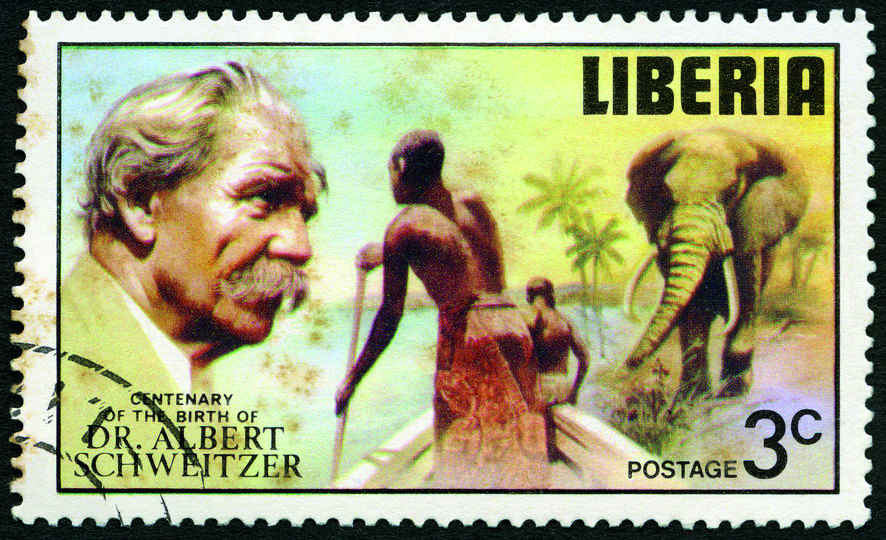
Those who thank God much are the truly wealthy. So, our inner happiness depends not on what we experience but on the degree of our gratitude, whatever the experience. Your life is something opaque, not transparent, as long as you look at it in an ordinary human way. But if you hold it up against the light of God’s goodness, it shines and turns transparent, radiant and bright. And then you ask yourself in amazement: Is this really my own life I see before me? -- (from “Reverence for Life”)
"Your life is something opaque, not transparent, as long as you look at it in an ordinary human way"
Postcript
On 11 December 1959, Dr Henry Friedman a close confidant and co-worker with Albert Schweitzer was awarded the Rosicrucian Humanitarian Award by the Southern Cross Lodge of the Rosicrucian Order in Johannesburg, Union of South Africa.
References
A moving documentary on Schweitzer’s life can be found at https://www.youtube.com/watch?v=Gf4B9v0s0CY Each of the following books was written by Schweitzer or is an edited collection of his letters: • The Africa Sermons. • African Notebook. • The Albert Schweitzer-Helene Bresslau Letters 1902 – 1912. • Albert Schweitzer and Alice Ehlers: A Friendship in Letters. • Albert Schweitzer Letters 1905 – 1965. • Brothers in Spirit: The Correspondence of Albert Schweitzer and William L Mellon, Jr. • Christianity and the Religions of the World. • Goethe: Four Studies by Albert Schweitzer. • Indian Thought and Its Development. • The Kingdom of God and Primitive Christianity. • Memoirs of Childhood and Youth. • The Mystery of the Kingdom of God. • The Mysticism of Paul the Apostle. • On the Edge of the Primeval Forest and More from the Primeval Forest. • Out of My Life and Thought. • Paul and His Interpreters: A Critical History. • A Place for Revelation. • Peace or Atomic War? • The Philosophy of Civilisation. • The Problem of the Lord’s Supper. • The Psychiatric Study of Jesus. • The Quest of the Historical Jesus. • Reverence for Life (Sermons). • The Story of My Pelican.
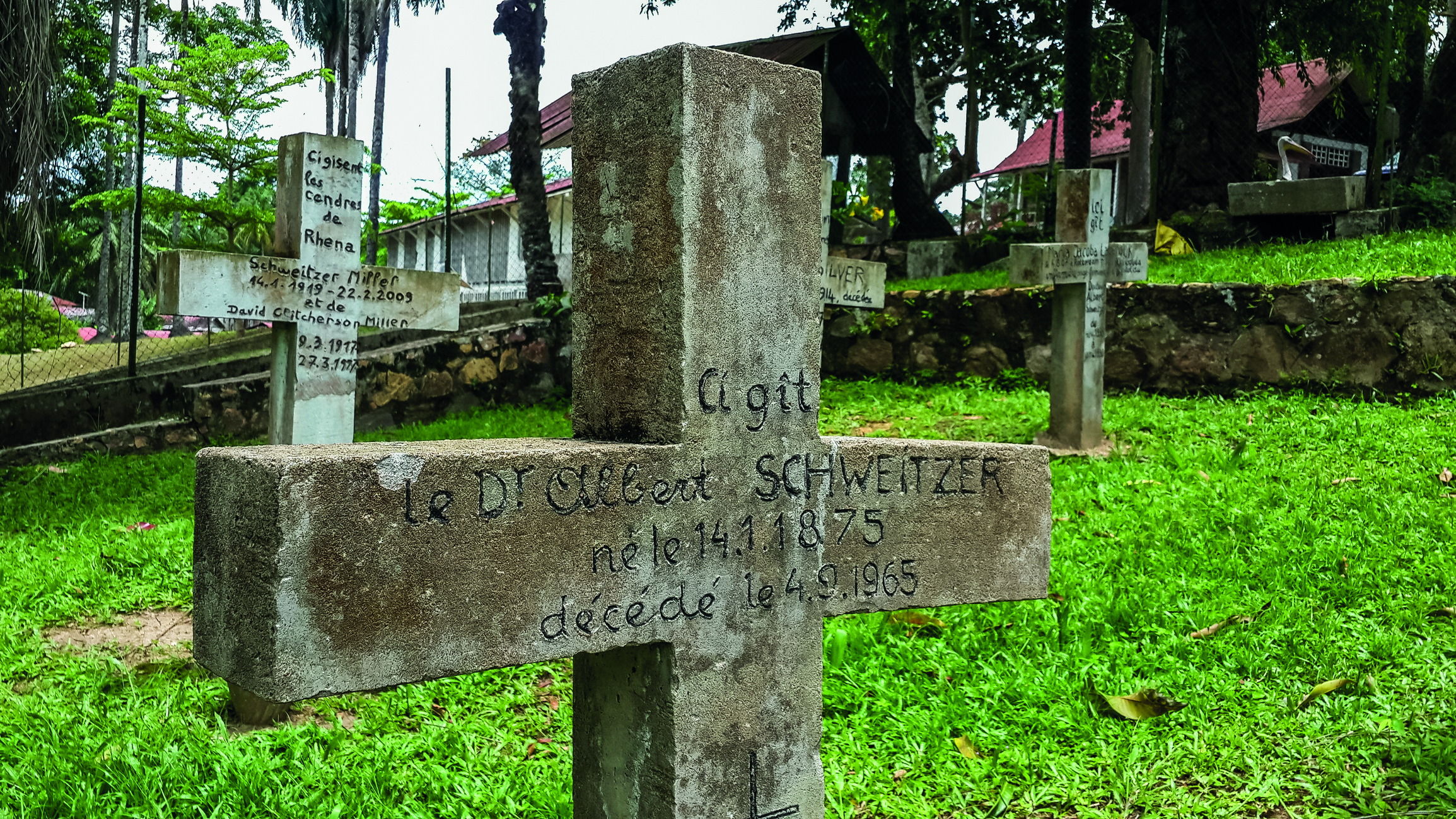
A simple concrete gravestone today marks the resting place of Albert Schweitzer at his hospital in Lambaréné, Gabon.